
He Turned Down a $1M Job Offer Because He Had a Novel Idea. Then He Grew That Business to $22M in 3 Years.
A typical new Rolling Suds franchisee needs between $350,000 and $450,000 in capital to launch.
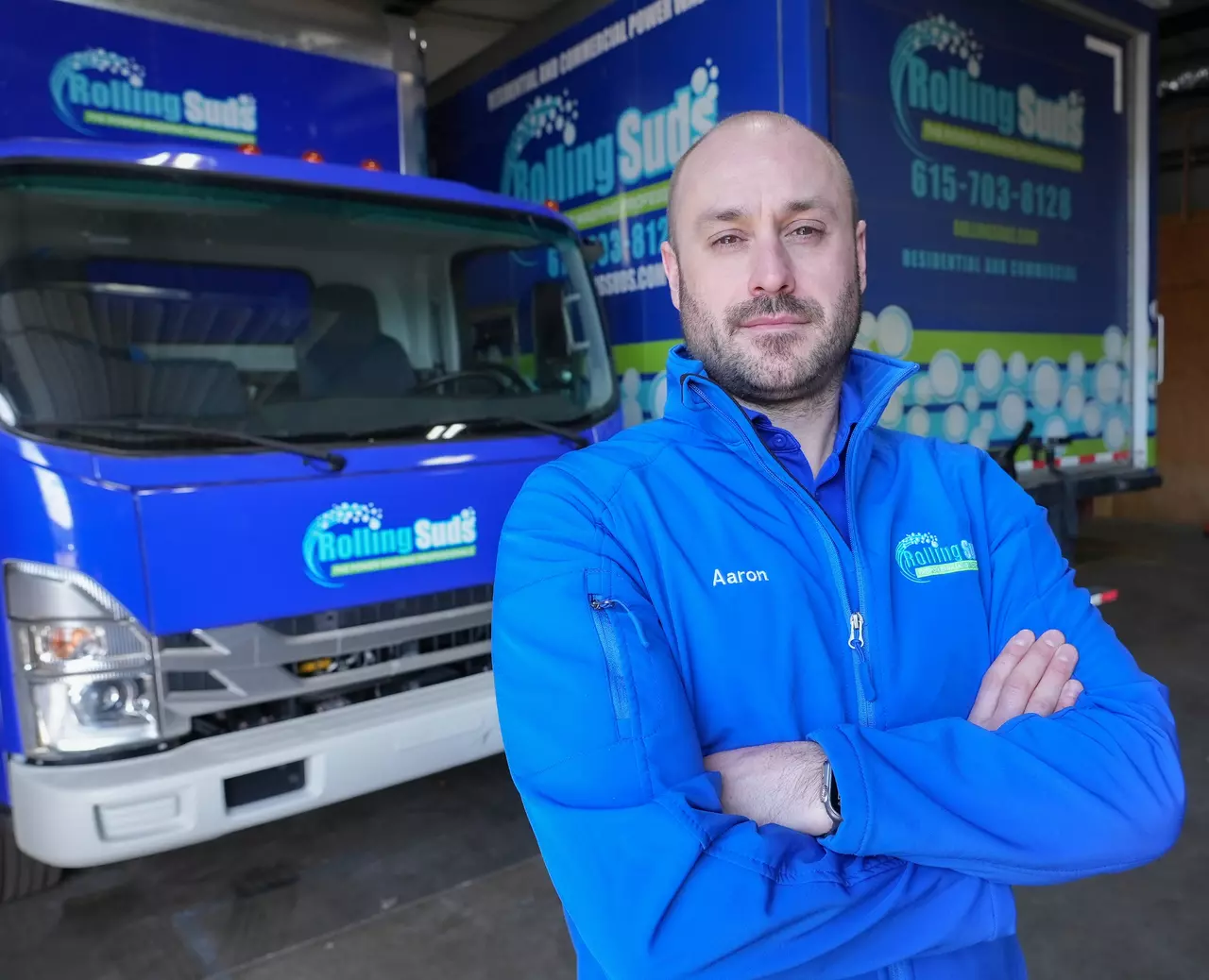
Aaron Harper. Credit: Rolling Suds
Rolling Suds
Key Takeaways Aaron Harper walked away from a $1 million-a-year VP role at Belfor Franchise Group to build his own franchise system instead. He used a “franchise through acquisition” model to turn 35-year-old Rolling Suds into a franchisor. From January 2023 to about three years later, Rolling Suds has scaled from one location to 356 territories across 37 states and $22 million in systemwide revenue.
Aaron Harper sent the email that blew up his career on an ordinary weekday afternoon. His boss at Belfor Franchise Group had asked for a project update, and Harper, moving fast as usual, fired off a reply without checking which inbox he was in.
It turns out, he sent the email from his account at Franchise Overdrive, the single-member LLC he had quietly formed to go out on his own. He had already started hunting for a lucrative business to franchise.
“What’s Franchise Overdrive?” his boss asked in front of other executives on a call. Moments later, his boss asked the question that made it all real: “Aaron, do we need to have a meeting after this?”
Harper said yes. He came clean and told his boss that he was exploring a venture of his own. His boss was supportive, saying that he would rather Harper start a company than go work for the competition.
Still, Belfor wasn’t ready to let Harper go without a fight. Shortly after, Harper turned down the kind of offer most corporate climbers dream about: a vice president role at Belfor with on-target earnings of around $860,000 a year and a clear path to seven figures after bonuses. He wanted to build his own franchise system instead.
“Even if I stayed at that company and made a million bucks a year, I knew that I would’ve had to basically be more reactive in hiring and recruiting and building the systems than I would want to be,” Harper tells Entrepreneur in a new interview. “I turned the job down because I had an incredible sense of purpose.”
Harper had a “great idea” — to acquire a local business by having them come on as an investor in a newly created entity. He didn’t want to buy the operating business in the traditional sense. Instead, he wanted to engineer what he calls “franchise through acquisition.” Rather than pay a premium for the local company and then still need millions of dollars more to build out their franchise system, he aimed to create a new franchise entity, raise capital for that entity and bring the founders in as minority equity partners. The founders kept ownership of their original power washing operation.
“All of the capital that I invest is gonna go into supporting franchisees and building the franchise system,” he explains. “The founders get to now have ownership in two companies.”
Aaron Harper. Credit: Rolling Suds
Engineering a franchise through acquisition
Instead of taking the promotion, Harper bet on a different playbook. He began systematically evaluating service businesses he could turn into franchises, about 23 different industries across the country. He looked at everything from roofing to plumbing, exploring industries like solar, tree care and insulation. He wasn’t looking for a trendy startup; he was looking for an overlooked workhorse that could be professionalized and scaled.
He eventually found it in a 35-year-old power washing company in suburban Pennsylvania called Rolling Suds, a family business started in 1990 with strong unit economics and no national competitor in its category. “I knew I could replicate that company in every market after I dug into the power washing industry as a whole,” he says. “It was largely made up of mom and pop operators with no defined national player in the industry.”
Harper put $155,000 of his own money into the deal and raised additional capital from six other investors, including former International Franchise Association chair David Barr and Fishman PR founder Brad Fishman. He acquired the brand in January 2023, launched the first franchisee in June 2023 and then stepped on the gas. Within three years, as CEO, he grew Rolling Suds from a single-location power washing business to 356 territories across 37 states, with about 100 franchise owners and $22 million in systemwide revenue.
How he grew the company
That kind of hypergrowth didn’t happen by accident. Harper spent six to nine months before the first franchise launch quietly building the infrastructure franchising requires: suppliers, call centers, accounting partners, marketing vendors and outbound call centers. “The franchisees who sign up are gonna say, ‘Who’s gonna answer the phones? Where are my leads gonna come from? How am I gonna find employees?’” he says. “If you, as a franchisor, don’t have the answers to every single one of those questions, it’s gonna be very difficult to award franchises.”
Once the foundation was in place, he moved into a sprint that blurred the boundaries between work and life. His daily schedule stacked one demanding job on top of another: “I would wake up, run the business till 7:45 a.m., I would then hop on calls from eight to six doing franchise development… and then from eight to midnight or 11, I would be running the business.”
For the first 14 months, he was hiring a new employee roughly every 13 days. He personally awarded the first 160 units, guiding each franchisee from the intro call to the signed agreement.
While Rolling Suds does offer its services as a residential home-services brand, Harper says that its economic engine sits elsewhere. Around 60% to 70% of the company’s work is commercial, not residential, and much of it is contracted as recurring revenue for five or six years at a time.
“Once franchisees get the parking structure, the shopping center, the mall, the high school on contract to wash those buildings, that business doesn’t ever want to [leave] as long as they do a good job,” he says. “Year two, your margins expand because now you’ve got contracts, and once you’ve paid for that customer once, you never have to pay for the customer again.”
That recurring, business-to-business-heavy model is also why Rolling Suds isn’t looking for hobbyist owners. A typical Rolling Suds franchisee needs between $350,000 and $450,000 in capital to launch — enough to secure two territories, two trucks, initial payroll, equipment and working capital.
Aaron Harper. Credit: Rolling Suds
Harper says his team has already turned away over 100 applicants who had the money but not the ambition or appetite for scale. “We’re not looking for that owner” who wants a one-truck lifestyle business, he says. “We’re looking for people who want to come in and execute ruthlessly and really grow a sizable company.”
Transitioning from CEO to chairman
As Rolling Suds crossed into the hundreds of locations, Harper’s own role shifted. He had always known he was a “zero to one” leader, suited to building something from nothing and getting it to a national scale quickly. “It’s a very different skillset for someone to go from 300 to 500,” he says. “I knew that once we reached that 250 to 300 unit range, I would not be the guy to get us to the next level of growth.”
In October 2024, he began quietly recruiting a seasoned CEO. By July 2025, he had hired industry veteran Tom Gissler to run the company and moved into the chairman of the board role.
“Really, it’s continuing to grow, knowing where my limitations are, filling those roles, reinvesting in the business, finding great people, building teams, reinvesting in the business, finding more great people, continuing to build teams and just continuing the growth trajectory,” he says. “But I can’t take credit, I just basically had a great idea and I recruited great people to help execute it. But I do very little today in the business because I have great people running the company.”