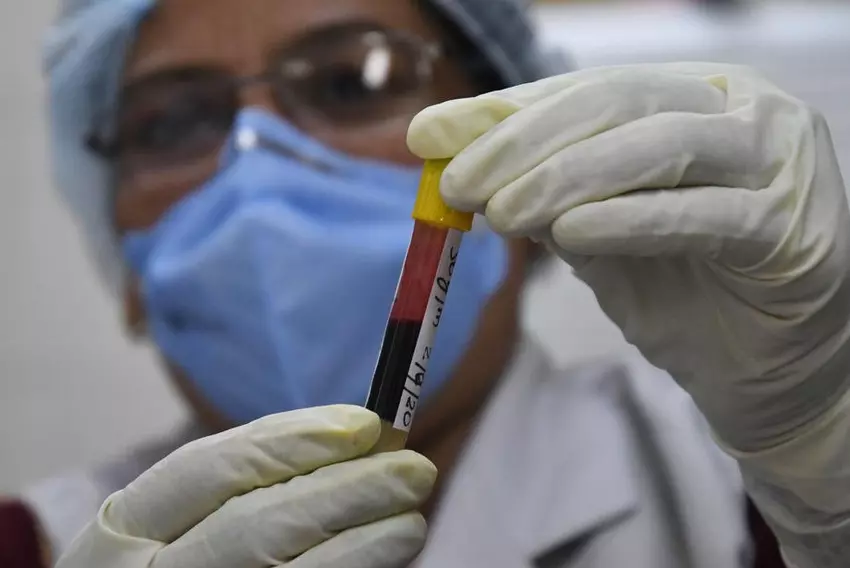

Simple blood tests can predict Alzheimer's onset, researchers say
Alzheimer's disease researchers say they've built a method using simple blood tests to predict if and when someone may show symptoms of the illness.
ST. PAUL, Minin., Feb. 27 (UPI) -- A team of U.S.-based scientists say they have developed a model using a "biological clock" to predict -- with just a simple blood test -- when someone is likely to develop symptoms of Alzheimer's disease.
The results of a study published this month in the journal Nature Medicine demonstrate how, by measuring blood plasma levels of a protein in people who are not yet impaired by Alzheimer's symptoms, researchers can predict when cognitive decline will begin within a margin of three to four years.
While there is no single, stand-alone test to diagnose Alzheimer's today, the new method works by leveraging how levels of the protein "p-tau217" in the blood closely reflect how much amyloid plaque has built up in the brain over time. This provides doctors with a "clock" that points to when a patient may begin to experience symptoms.
Amyloid buildup in the brain may begin up to 20 years before a person starts to experience symptoms of memory and thinking issues. The plaques are a key pathological hallmark and contributing factor in Alzheimer's disease, and, much like looking at the rings of a tree, p-tau217 levels can reveal the age of the buildup.
The authors, based at the Washington University School of Medicine in St. Louis, say their new blood test method will have immediate applications in ongoing clinical trials seeking answers to the vexing questions about what causes and what can prevent Alzheimer's and dementia, which affect more than 7 million Americans at an estimated cost of nearly $400 billion in 2025.
Eventually, with further refinement, researchers hope the blood test could one day be used in clinical settings to easily and quickly provide predictions about the timeline of symptom onset for individual patients. The only feasible ways of doing so now are through costly brain imaging scans and invasive spinal fluid tests.
The study was part of a project headed by the Foundation for the National Institutes of Health Biomarkers Consortium, a public-private charitable partnership established by Congress in 1990 whose roster includes schools such as Washington University, life science companies including Johnson & Johnson and the Alzheimer's Association.
Dr. Suzanne Schindler, senior author of the study and associate professor in the WashU Medicine Department of Neurology, said that while current blood tests for p-tau217 are already capable of identifying cognitively unimpaired people who might develop Alzheimer's symptoms, they have no ability to estimate when.
Thus, they are used only for research studies and clinical trials due to legal and ethical considerations, such as the risk of causing undue stress from uncertain results.
"Our study, however, suggests it's possible to predict when symptoms might develop using blood p-tau217," she told UPI. "The prediction is very rough and so is still only useful in research or trials.
"We believe these predictions can be refined, but it's unclear if they'll become reliable enough for individual guidance without more invasive tests like spinal fluid analysis," she cautioned.
Still, the potential of uses of the blood test are immediate when it comes to Alzheimer's research. For instance, they could allow clinical trials of potentially preventive treatments to be performed within a shorter time period.
"Clinical trials are currently underway that are treating cognitively unimpaired individuals who test positive for blood p-tau217," Schindler noted. "We must wait to see if these treatments delay or prevent symptom onset, but I'm hopeful based on our understanding of the disease's biology."
Beyond clinical trials, the blood test will aid broader Alzheimer's research "by linking p-tau217 levels to specific brain changes, helping us disentangle whether those changes are driving cognitive impairment amid its overall complexity," she added.
The new study "provides evidence that plasma p‑tau217 may be a reliable tool for estimating the future onset of Alzheimer's disease symptoms," agreed Rebecca Edelmayer, vice president of scientific engagement for the Alzheimer's Association.
"This could transform how researchers design clinical trials and, eventually, how clinicians identify people at highest risk for cognitive decline associated with Alzheimer's years before decline begins," she told UPI.
While the blood test method represents a "very intriguing discovery," it's important to note it is not yet ready for everyday use by doctors or patients, Edelmayer cautioned, noting that its three- to four-year margin of error effectively rules out its utility for individual decision-making.
Broadly speaking, blood tests are not yet recommended for cognitively unimpaired individuals outside research settings, but even so, "this finding is an important research step because a blood test is generally much less expensive and easier to administer than a brain scan or spinal‑fluid test," she said.
"In the future, it could help doctors and researchers identify people who may benefit from early treatments, and make clinical trials for new Alzheimer's therapies run faster and more efficiently."
The possibility of making a difference in the long-running battle against one of the most feared and intractable diseases in the world holds a special meaning for Schindler.
"As a memory specialist, I've diagnosed over 1,000 people with Alzheimer's and witnessed firsthand its devastating effects on patients and families," she said. "These results make me hopeful, and it's rewarding to think this research could improve diagnosis and treatment of Alzheimer's."