
Boeing looks to familiar faces for new 737 Max assembly line
Boeing will move workers from its Renton and Moses Lake, Washington, factories to Everett to staff a fourth 737 Max production line, set to open this summer. The new manufacturing line will be equipped to build the Max 8 and Max 9 already in production in Renton, Washington, as well as the Max 10, a larger Max variant that has yet to be certified to carry passengers by the Federal Aviation ...
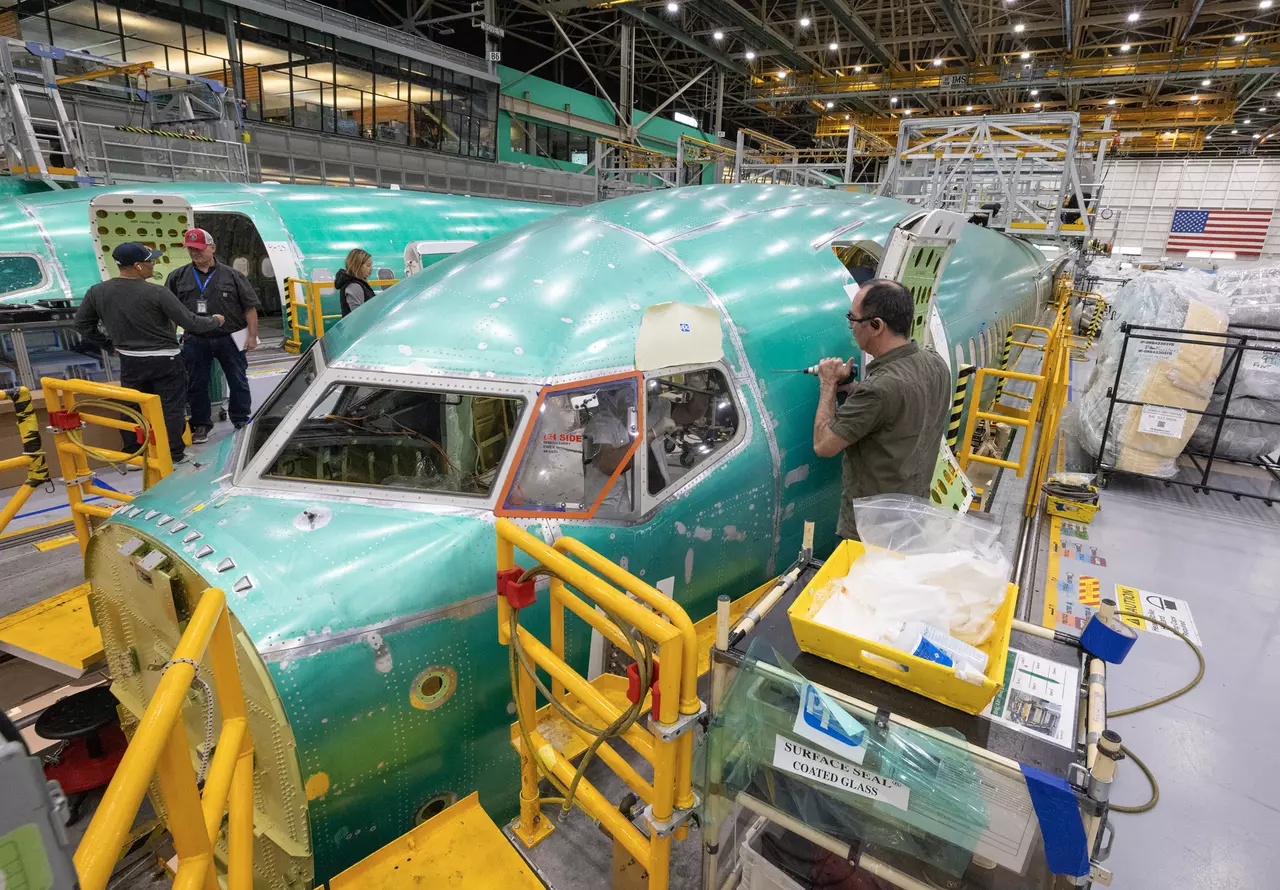
Boeing 737 Max 8 s on the flow day 1 upper line, Oct. 15, 2025, in Renton, Washington, during a tour focusing on Spirit fuselage inspections.
Ken Lambert/The Seattle Times/TNS
Boeing will move workers from its Renton and Moses Lake, Washington, factories to Everett to staff a fourth 737 Max production line, set to open this summer.
The new manufacturing line will be equipped to build the Max 8 and Max 9 already in production in Renton, Washington, as well as the Max 10, a larger Max variant that has yet to be certified to carry passengers by the Federal Aviation Administration.
Speaking to investors at a Bank of America conference Tuesday, Boeing Chief Financial Officer Jay Malave said the new production line will be an exact replica" of the three lines already churning out 737 Max planes in Renton. The Everett line, which Boeing calls its North Line, will enable the manufacturer to build more Maxes each month.
Boeing is currently producing about 42 Maxes monthly and plans to increase to rate 47 in Renton this year.
“Anything above 47,” then, will be built in Everett, Malave said.
It’s not clear how many workers Boeing will relocate from Renton and Moses Lake to the Everett site, or how many employees will work on the North Line. A spokesperson declined to share those numbers.
At the Bank of America conference, Malave said the North Line workforce is a mix of new hires and employees from Renton and Moses Lake. Boeing has already begun training the North Line team in Renton, Malave continued.
Boeing expects to start building its first 737 Max in Everett this summer, but it will start slowly. That "first build" will take a "number of months," Malave said.
The North Line will "bump up" to a rate of two 737 Max planes per month in 2027, Malave said. It will take a few years to reach what will be the North Line’s normal cadence, he continued.
“The stands are in place. The line is ready to go,” Malave said.
Boeing CEO Kelly Ortberg said last year that Everett’s North Line would “primarily focus” on building the 737 Max 10 because it “has the most complexity” of the four Max models and would likely require a slower rate of production. Clearing the Max 10 to a separate line would allow Boeing to keep its other three Max production lines in Renton moving efficiently, Ortberg said.
Boeing doesn't plan to outfit the North Line to support the Max 7, a smaller variant of the Max that has also yet to be certified by the FAA, but could do so in the future, a spokesperson said.
Malave and the spokesperson did not say what Max model Boeing will build on the North Line when it gets started this summer.
Boeing has been steadily increasing Max production since a midair fuselage blowout in January 2024 forced the manufacturer to slow the pace of work. The FAA capped Boeing’s Max production rate following the panel blowout, and worked with the company to design a set of safety and quality metrics to determine when it could again increase production rates. The FAA granted Boeing permission in October to move from 38 planes per month to its current rate of 42.
Last year, Boeing delivered 600 airplanes, including 440 Max planes, marking its highest annual delivery total since 2018. Boeing has maintained that cadence so far this year, delivering 46 airplanes in January, including 37 737 Maxes, and 51 airplanes in February, including 43 737 Maxes.
On Tuesday, Malave said Boeing had addressed a manufacturing issue that briefly halted 737 Max deliveries earlier this month.
Boeing disclosed last week it was reworking some 737 Max planes after identifying small scratches on wires due to a machining error. On Tuesday, Malave said a machine in one of Boeing’s factories wasn't correctly calibrated, causing the scratches. He did not specify where the issue was identified, or what types of wires were scratched.
The issue affected about 25 aircraft that had not yet been delivered to customers. Boeing expects it will take about three days of “rework” per plane to address the issue.
The manufacturer resumed Max deliveries last week, Malave said.
Like many Boeing executives, Malave said 2025 was a strong year in Boeing’s effort to recover from a brutal 2024, following the panel blowout and a Machinists strike that stopped production in Boeing’s Puget Sound-area factories for nearly two months.
But, like other Boeing executives, Malave said the long delay to certify new airplane programs — including the 737 Max 7 and 10, and the 777X family — continues to hang over the company. Boeing again pushed back its timeline last year for delivering those new models to customers. That “reset, while painful, now puts us on a schedule we can perform to,” Malave said Tuesday.
Boeing, which saw its workforce dwindle amid the COVID-19 pandemic, has struggled in recent years to hire and retain enough skilled workers to fill gaps left by retirements. But, on Tuesday, Malave said that problem was mostly behind them.
Since he joined the company in August, Malave said he has seen a shift in employee sentiment that he believes is driving retention.
“I just saw a change, really, a level of enthusiasm, because employees started to believe that we could recover,” Malave said. “High turnover really hasn’t been an issue for us for a little while now.”
Boeing's Washington workforce shrunk 4% last year, from 67,000 workers in 2024 to 65,000 in 2025. The drop reflects companywide job cuts announced during a financially ruinous 2024, offset by Boeing's efforts in the second half of 2025 to hire more workers to pick up the pace of Max production.
Malave said Boeing now has the staffing it needs to meet its production goals, particularly increasing monthly Max production from 42 to 47 planes later this year. “Now," he said, it’s a matter of training.”