
Illinois 2026 GOP primary for governor features four candidates and one familiar face but big donors sit out
Four years ago, the six-way Republican primary for governor was impossible to miss. More than $100 million was spent largely on TV ads, including $35 million from Democratic Gov. JB Pritzker, who not-so-subtly steered GOP voters toward the candidate he deemed easiest to defeat that fall: Darren Bailey. A downstate farmer and former state lawmaker who leaned heavily on his evangelical Christian ...
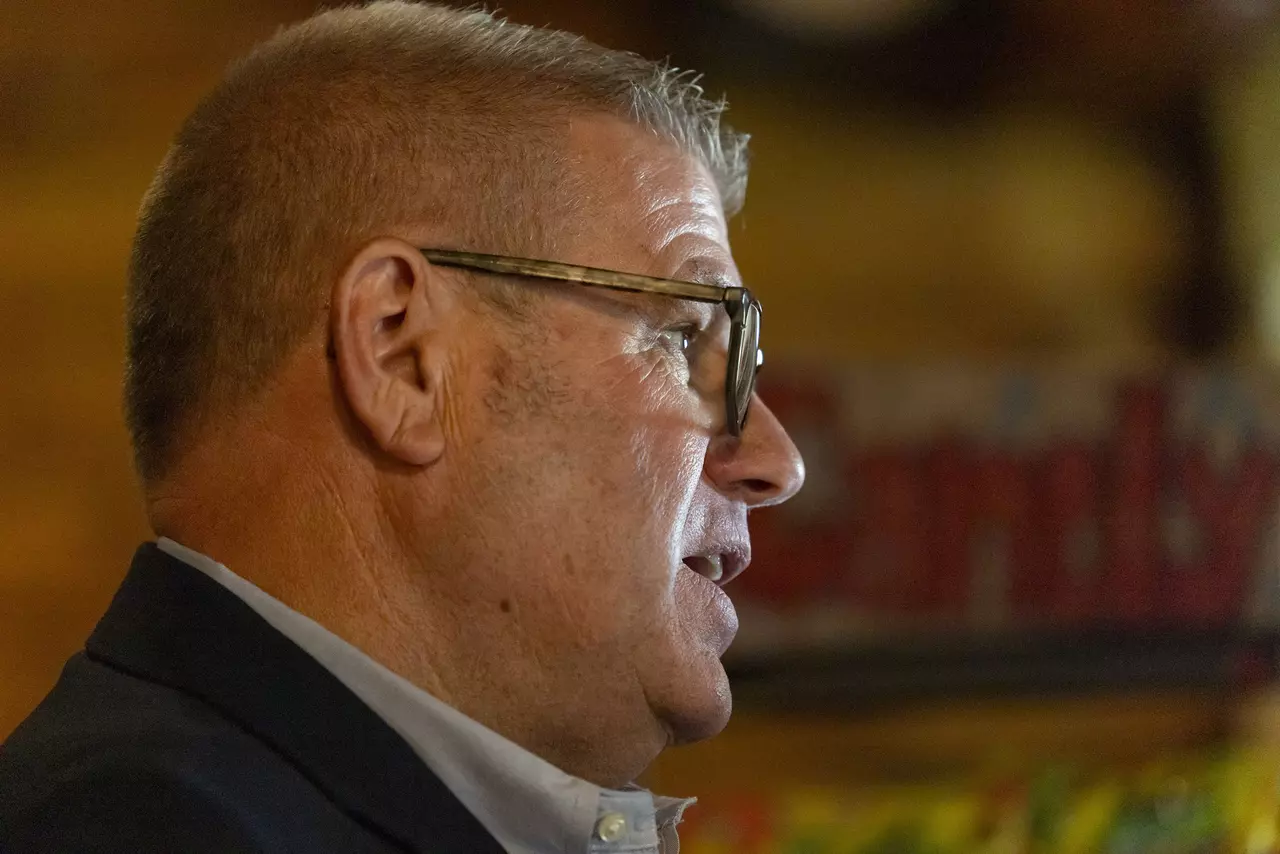
Darren Bailey speaks after announcing his Republican primary bid for governor, Sept. 25, 2025, at Turner’ s Table in Carterville, Illinois.
Brian Cassella/Chicago Tribune/TNS
Four years ago, the six-way Republican primary for governor was impossible to miss. More than $100 million was spent largely on TV ads, including $35 million from Democratic Gov. JB Pritzker, who not-so-subtly steered GOP voters toward the candidate he deemed easiest to defeat that fall: Darren Bailey.
A downstate farmer and former state lawmaker who leaned heavily on his evangelical Christian faith, Bailey won that primary — then lost to Pritzker in November by nearly 13 percentage points. Now, he’s back, seeking a general election rematch in a GOP primary field of four.
Almost nothing else from 2022 has returned with him.
Gone are the multimillion-dollar budgets, such as the $50 million Citadel founder Ken Griffin poured into the campaign of then-Aurora Mayor Richard Irvin, who finished third in the primary and then lost reelection for his municipal office a year later. Shortly before Irvin’s collapse at the ballot box, Griffin announced he and Citadel were packing up and leaving Illinois for Florida.
Gone, too, is the $18 million ultra-conservative megadonor Richard Uihlein, founder of the Uline office supply business, directed toward Bailey’s effort and into an allied political action committee that opposed Irvin in the primary. This cycle, Uihlein has contributed a comparatively modest $250,000 to one of Bailey’s rivals, Ted Dabrowski, a right-wing policy analyst.
And Pritzker, seeking a third term, hasn’t seen the need to meddle in the GOP primary. He didn’t air his first reelection ad of the 2026 campaign until 19 days before the March 17 primary, while the businessman and heir to the Hyatt Hotels fortune devoted millions of dollars to help his lieutenant governor, Juliana Stratton, try to win a U.S. Senate seat.
The result is a race between Bailey, Dabrowski, real estate developer and video gambling firm owner Rick Heidner and DuPage County Sheriff James Mendrick that is a largely low-key, low-budget affair as the candidates have been forced to seek out voters through GOP gatherings such as downstate Lincoln Day dinners and social media videos rather than television.
All four pledge their allegiance to Republican President Donald Trump despite his continued unpopularity in Illinois, though none can claim his endorsement.
Heidner of Barrington Hills initially billed himself as the “Trump Republican for Governor,” and said he was aligned with the president on business and economic growth. Mendrick of Woodridge cites Trump’s support for law enforcement, saying “Trump may say things that alarm people sometimes, but he’s saying what we’re all thinking.”
Dabrowski of Wilmette credits the president for closing the southern border and backing private schools but breaks with him on tariffs. And Bailey of downstate Xenia, who actively courted and won Trump’s endorsement in 2022, has tried to create some distance this time around, telling voters: “I am Darren Bailey and I am running for governor of Illinois alone, without any outside influence other than what exists here within this state.”
Dabrowski, who is the former president of the conservative Wirepoints activist organization, has framed the dynamic similarly.
“We have to rely on Trump to do those big things out there,” he said, “but we have to fix our own problems.”
Immigration a key issue
All four candidates support Trump’s immigrant deportation efforts and blame the aggressive actions of federal Immigration and Customs Enforcement and Customs and Border Protection agents on the state’s sanctuary status, and they contend protesters have been provoked by Pritzker’s rhetoric. In addition to pushing back against Trump’s deportation actions and efforts to deploy National Guard troops onto public streets, Pritzker has been a staunch supporter of the state law — formally known as the TRUST Act — that prevents state and local law enforcement from cooperating with federal immigration agents who lack judicial warrants. The TRUST Act was approved by Pritzker’s Republican predecessor, one-term Gov. Bruce Rauner.
Heidner contended that had state and local law enforcement been allowed to cooperate with federal immigration enforcement agents during Operation Midway Blitz in “six to eight weeks, they would have been out of here.”
“What do you think about the two people that died in Minnesota? What about all those people who died because of these criminals?” Heidner said at a recent rally, alluding to the deaths of Renee Good and Alex Pretti, two U.S. citizens who were shot and killed in Minneapolis by federal immigration agents in January.
“You’re talking about highly trained ICE agents, right? But you keep pushing and pushing and prodding and spitting, you know, and throwing ice and throwing bricks, what do you think’s eventually” going to happen, Heidner asked, despite national reports that the newest immigration agents are undergoing lax training on standards, including for the lethal use of force.
The four candidates also vow to seek to repeal the TRUST Act, even though the U.S. Constitution assigns immigration enforcement to the federal government.
Dabrowski has gone the furthest, saying he would use executive orders declaring an “emergency” to revoke both the TRUST Act and the SAFE-T Act, which eliminated cash bail — a legally dubious promise given that previous emergency declarations have addressed acute public health crises.
Citing Pritzker’s use of “emergency” declarations in dealing with COVID-19, Dabrowski said, “We’re going to do the same thing for crime and for illegal immigrant crimes. We’re going to work to get rid of the SAFE-T Act. We’re going to work to get rid of the sanctuary state, and we’re going to for safety.”
Bailey has taken a more measured approach, emphasizing that the public needs to understand the TRUST Act and the immigration process as part of a larger effort to build legislative support to overturn the law.
“I would venture to say most people in Illinois don’t understand it is a law that state and local people can’t work with federal law enforcement” on immigration, Bailey said. “So maybe educating people and explaining how and why that is — and I’ll be doing that on day one.”
He has also said that “whatever we can do to help people become naturalized citizens” should be pursued. And Heidner said he differs with Trump by wanting to see a path to citizenship “for illegal immigrants that have been here a long time and been good citizens and have homes and pay taxes and have kids in school.”
Mendrick’s rhetoric on immigration has been the most combustible. At times, he has echoed the debunked white nationalist “Great Replacement” conspiracy theory.
“We are being replaced,” he said after a recent debate, though he maintained his comments had “nothing to do with whites. This has a thing to do with citizens and non-citizens.”
In becoming the first GOP candidate to announce for governor in February of last year, Mendrick sounded the replacement warning, saying, “Our culture is being eliminated by senseless laws created by our current government that persecutes cops and empowers criminals. I’m here to stop the bleed.”
Speaking to supporters at an East Dundee gun shop on Jan. 19, Mendrick said, “Think about this, folks, we’re being washed out,” contending hundreds of thousands of illegal immigrants coming into the state have made up for citizens leaving Illinois.
“Then we’re replaced. ‘You’ve got to come through me. These are my people.’ Those are Pritzker’s words,” the DuPage County sheriff said. “Well, guess what, folks, you’re my people. The state of Illinois citizens. It’s the citizens that are important. We are being run over.”
Mendrick also has said he supports eliminating the SAFE-T Act, formally known as the Safety, Accountability, Fairness and Equity-Today law, because it imposes new restrictions on law enforcement. But he said he supports its cashless bail provision.
“I don’t think a rich guy should be able to buy their way out of jail and a poor person has to stay,” he said.
Tax plans still mostly TBD
Like immigration, property taxes have united all four candidates as a campaign issue — though none has offered a fully funded plan to cap or reduce taxes without affecting the local grade and high school funding that makes up the bulk of residential property tax bills.
Bailey, for example, proposed an annual cap on property tax rates linked to a taxpayer’s mortgage rate, with increased state funding for schools to help reduce real estate taxes. But he has not specified where the additional state funding would come from. He also has proposed creating a state Department of Government Efficiency modeled loosely on Trump’s much-ballyhooed federal version that failed to achieve its cost-savings objectives, though he said it would not focus on job eliminations.
Dabrowski has called for a 1% percent cap on property taxes and criticized state mandates on local governments, including pension and collective bargaining requirements, that he says drive up costs. He has floated using artificial intelligence to replace municipal office workers and proposed consolidating administrative functions across the state’s nearly 900 school districts, though he said district mergers should remain local decisions.
“With this AI, with all this technology coming on, can you imagine the consolidation of all the back offices of all these units of government? Save tons of money, lower property taxes,” he told a group of supporters.
Heidner supports taxpayer incentives to retain and lure businesses and said that could lead to lower taxes.
“We don’t have to raise any taxes with the tax base we have. By creating more business, we naturally get more taxes. So, we get more taxes, we lower the bills,” Heidner said.
Mendrick’s position on taxes was slightly different.
He has criticized Pritzker’s reductions in the portion of state income taxes that go to local governments and also the diversion of road fund dollars for other transportation purposes. But at a dinner for the legislature’s far-right Illinois Freedom Caucus in February, Mendrick went further, threatening to use the state police against Pritzker if elected, citing the governor’s actions on taxes.
“I’ll be in charge of the state police, and they’re all going to jail,” he said, alleging without evidence that the governor had illegally diverted fuel tax and local government revenue. “He will go to jail for sweeping the local tax.”
Mendrick also has said he would not enforce the state’s ban on certain high-powered semiautomatic weapons — a stance associated with the fringe “constitutional sheriffs” movement, which holds that county sheriffs are the ultimate authority in determining a law’s constitutionality. The movement was co-founded by an Oath Keepers co-founder. Mendrick said he does not consider himself a member of the constitutional sheriffs movement, while acknowledging: “I don’t know what, ultimately, my legal authority is.”
A member of the DuPage County sheriff’s department for 30 years and serving as county sheriff since 2018, Mendrick has touted his efforts to reduce recidivism in the jail while operating his office without overspending his budget. But in May of last year, DuPage County and Mendrick reached an $11 million settlement in a federal lawsuit brought by the estate of a 50-year-old mother who died in June 2023 after being held in the county jail for 85 days while awaiting transfer to a state-run mental health center.
‘I have zero ties to organized crime’
Heidner’s background has drawn scrutiny of its own.
The owner of Heidner Properties, a real estate development group that owns and manages commercial properties across the country, Heidner also owns Gold Rush Gaming, a video gambling operator, and Ricky Rockets Fuel Centers.
A 2019 Tribune investigation found that while Heidner was asking the state for permission to build a southwest suburban horse track and casino, he also had long-standing business ties to a banking family whose financial involvement with mob figures helped sink a Rosemont casino. Heidner also had a similar real estate partnership with convicted bookmaker Dominic Buttitta, where they owned a building in Elgin that was leased to a bar using Gold Rush machines. Buttitta pleaded guilty in 2012 to federal charges of running an illegal sportsbook from the South Elgin strip club he controlled.
Following the Tribune investigation, Pritzker scuttled Heidner’s plans to build the horse racing track and casino on state-owned land in Tinley Park. Heidner and state gaming regulators later reached a settlement in 2021 after the state withdrew allegations that he had offered an illegal $5 million inducement to purchase a rival video gambling chain.
“I have zero ties to organized crime,” Heidner said at a recent debate. “Shady ties? Where’s the shady ties? Where’s the shady ties? You know, people want to say shady ties. … I was totally vindicated.”
Asked by a reporter after the debate whether his gubernatorial bid was partly driven by grievances against Pritzker, Heidner didn’t hesitate.
“Absolutely not. Do I like what happened to me? Was it fair? Absolutely not. Did it hurt me and my family tremendously? Absolutely,” he said.
Heidner has also given campaign contributions to prominent Democrats, including $2,500 to former Cook County State’s Attorney Kim Foxx and $25,000 to Chicago Mayor Brandon Johnson. He acknowledged at a debate that he had wanted to discuss bringing video gambling to Chicago with Johnson. Dabrowski called the donations “pay-to-play politics.”
Dabrowski had an inauspicious launch of his campaign in September, speaking for less than nine minutes in front of his home and taking no questions from reporters.
In addition to serving as president of Wirepoints, he previously worked as the senior vice president at the conservative-aligned Illinois Policy Institute.
His campaign has gained the backing of controversial right-wing radio host and political operative Dan Proft of Naples, Florida, as well as far-right former legislator Jeanne Ives, now a member of the Republican State Central Committee. Proft had unsuccessfully sought to use Uihlein’s money to take control of Bailey’s 2022 gubernatorial bid.
Bailey 2.0 seeks to become a humbled, chastened alternative to the original version, as he called Chicago a “hellhole” based on his southern Illinois perspective of the state.
“I realized calling Chicago a ‘hellhole,’ carrying the message that I carried the last time, trying to do that doesn’t work for Illinois. I respect that and I appreciate that,” Bailey said.
“I probably acted like a bull in a china cabinet the first time and I realized that it’s got to be different because people aren’t going to talk to you or with you when you’re in that frame of mind,” he said.
With a vastly smaller campaign fund than what he had four years ago, Bailey is relying on name recognition from his first run for governor, along with social media and local GOP events, to promote his candidacy.
“Illinois is different, and that’s why I’m different,” he said, comparing his campaign to the one four years ago. “The people know that I’m sincere, I’m genuine. This isn’t a fake. This isn’t a fake to win. This is who I am.”
_____