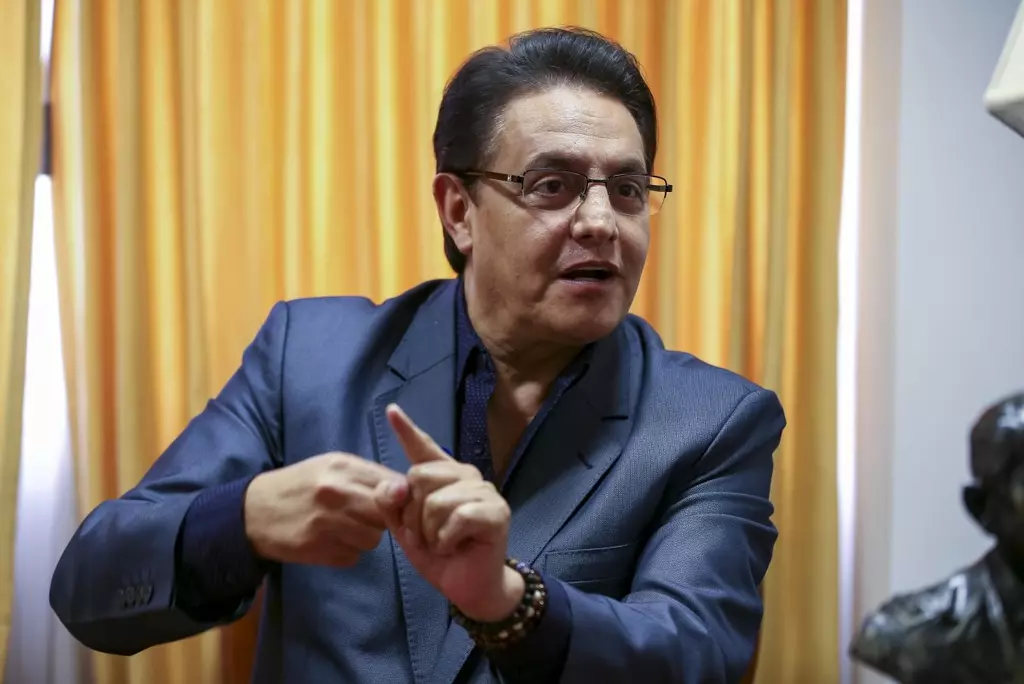

'Corruption kills': The spread of ethical decay
Fernando Villavicencio left a campaign rally in Quito and walked toward his vehicle. Moments later, gunmen opened fire. He died within minutes.
March 17 (UPI) -- On the evening of Aug. 9, 2023, Fernando Villavicencio left a campaign rally in Quito and walked toward his vehicle. Moments later, gunmen opened fire. He died within minutes.
Villavicencio was a presidential candidate in Ecuador's election. Before entering politics, he had built a reputation as an investigative journalist who exposed corruption at the highest levels of government. He had reported death threats. He had been given security. None of it saved him.
His killing shocked Ecuador, but it also revealed something deeper. What happened to Fernando Villavicencio, with important local variations, is repeated with disturbing regularity in other countries and contexts.
Corruption, when it spreads through institutions and joins forces with organized crime, does not remain an abstract problem. It becomes deadly.
By then, Ecuador had already seen surging violence, extortion and criminal infiltration. Villavicencio had warned that his country was becoming a narco-state. His murder gave chilling force to that claim. This was not only an Ecuadorian tragedy. It was a warning about a broader condition affecting much of Latin America and beyond.
A killing that revealed the deeper crisis
We are living through what I call a "pandemethic" crisis: a pandemic of ethical decay spreading across political and civic life. The term combines pandemia and ética -- ethics -- to name a process in which dishonesty becomes routine, corruption becomes tolerable, and citizens learn to treat public wrongdoing as normal. Like a pathogen, it spreads through contact and normalization: one unpunished abuse makes the next more likely. Over time, resignation replaces outrage. This is not simply a moral complaint. It is a way of naming a structural problem.
Many analysts explain today's democratic turmoil through polarization, inequality or authoritarian tendencies. Those factors matter. But they often describe the surface of the crisis, not its root. Beneath them lies a weakening of the ethical standards that sustain public life: honesty in office, respect for the law, and a sense of responsibility toward the common good.
When those standards erode, the consequences become visible in captured institutions, broken accountability and citizens who no longer trust the state.
When corruption becomes cultural
The data reflect that reality. According to Transparency International's Corruption Perceptions Index, the Americas have trended downward since 2012 and now average just 42 out of 100 -- a score that places the region among the world's most corruption-affected. Ecuador's own score fell from 39 in 2020 to 32 in 2024, one of the steepest drops in the hemisphere.
Democracy indices reinforce the picture: Latin America has recorded more than nine consecutive years of democratic regression, according to both International IDEA and The Economist's Democracy Index. Peru has been rocked by corruption scandals involving five former presidents. Guatemala once built an internationally respected anti-impunity mechanism, only to see it dismantled under political pressure.
Different countries show different symptoms, but the pattern is recognizable: institutions still exist, yet their credibility weakens and their capacity to restrain abuse declines.
Across Latin America, public trust has eroded as civil liberties have come under growing strain and institutional legitimacy has weakened. Many citizens no longer believe the rules are fair or consistently applied. That loss of confidence is not a side issue. It is part of the crisis itself.
Why trust keeps collapsing
When ethical decay becomes systemic, social anger rises. Protests then become not just political events but signs of deeper civic exhaustion.
That anger is often justified. Yet anger alone does not repair institutions. In some cases, legitimate protest is infiltrated by violent actors who redirect public frustration toward destruction and disorder. When that happens, the same ethical breakdown that helped produce the crisis begins to distort the response to it.
Impunity deepens the damage. When citizens watch powerful figures evade consequences again and again, they absorb a dangerous lesson: rules are flexible, and accountability and justice depend on status.
One of the most striking features of this crisis is that it does not belong to one ideology. Distrust now cuts across the left, center and right. Ecuador's decline has unfolded under different governments. Peru's instability has crossed party lines. Similar frustrations have surfaced throughout the region under leaders of varying political identities.
This suggests that the problem is not merely partisan. It is cultural and institutional at the same time.
Laws alone are not enough
That diagnosis is serious, but it is not hopeless. Ethical decay can spread, but civic resistance can also be strengthened.
Countries with stronger public ethics and more resilient institutions have shown greater capacity to contain corruption and preserve trust. In Latin America, Uruguay offers a useful example of relative institutional steadiness. Elsewhere, the Scandinavian democracies continue to demonstrate that accountability works best when it is supported not only by law but by civic habits.
That distinction matters. Laws are necessary, but they are not enough. Anti-corruption agencies, constitutional reforms and oversight bodies can help, yet they remain vulnerable when the surrounding culture tolerates abuse.
Democracies do not fail only because corrupt leaders rise. They also weaken when citizens excuse misconduct, vote through clientelist loyalties or stop expecting integrity from public life. Ethical decline is not imposed only from above. It is also reproduced below, in habits of resignation and accommodation.
For that reason, the answer cannot be limited to technical reform. Stronger institutions matter. Better laws matter. But democratic recovery also requires civic education, moral leadership and a renewed expectation that public office exists to serve, not to exploit.
Democracy is more than a procedure repeated at election time. It is a culture of responsibility, restraint and trust.
Fernando Villavicencio understood the danger. He warned that corruption kills. He kept speaking even when the risks were clear.
His murder showed what happens when ethical decay is allowed to harden into impunity. The question now is whether societies facing that danger will rebuild the moral foundations of public life, or continue to treat the disease as if it were only a passing fever.
Carlos Cantero is a Chilean academic at the International University of La Rioja in Spain and the author of Digital Society: Reason and Emotion. An international lecturer, adviser, and consultant, he focuses on adaptability in the digital society, ethics, social innovation, and human development. The views and opinions expressed in this commentary are solely those of the author.