
MINNEAPOLIS — Taylor Hastings will likely go down in “Love is Blind” history as the only contestant on the reality-dating show to ask each of her suitors if he’s had a colonoscopy. It was an unusual romantic icebreaker, but maybe it shouldn’t be. We’ve got to normalize talking about colorectal cancer screenings, says Hastings, an endoscopy nurse at M Health Fairview’s Southdale Hospital in ...

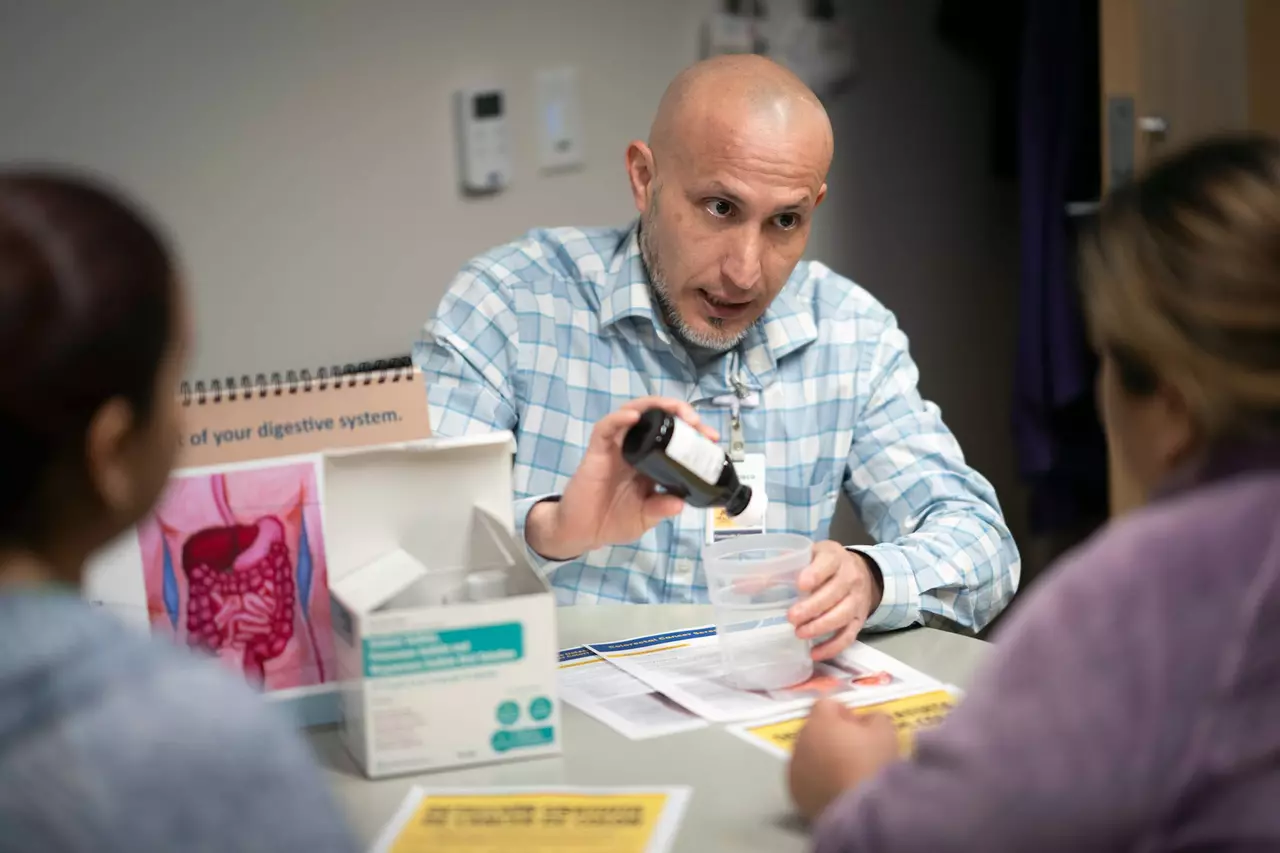
Francisco Ramirez of Fairview Health Services explains the process of a colonoscopy prep to two women at Prince of Peace Church’ s Mission Outpost in Burnsville on March 26.
Renée Jones Schneider/The Minnesota Star Tribune/TNS
MINNEAPOLIS — Taylor Hastings will likely go down in “Love is Blind” history as the only contestant on the reality-dating show to ask each of her suitors if he’s had a colonoscopy.
It was an unusual romantic icebreaker, but maybe it shouldn’t be.
We’ve got to normalize talking about colorectal cancer screenings, says Hastings, an endoscopy nurse at M Health Fairview’s Southdale Hospital in Edina. (And clearly, her conversation starter didn’t flatten her chances at love; she and husband Daniel were the only couple to marry during the Netflix series’ Minneapolis season, which aired last year.)
Beneath Hastings’ quirky sense of humor is a dire message. At 33, she can speak to a younger audience who should have colorectal cancer on their radar.
Diagnoses among people under 50 have been rising at an alarming rate, and it’s now the leading cause of cancer deaths among this age group. Actors James Van Der Beek and Chadwick Boseman were both in their 40s when they died from colorectal cancer. The disease also affects Latinos, Black people and Native Americans at higher rates than white Americans.
The new recommended age to start regular colonoscopies is 45, but people can get screened earlier if they have a family history. It’s imperative that people watch for symptoms, such as a change in bowel habits, like diarrhea or constipation, cramping, unintended weight loss or rectal bleeding. Hastings became more vigilant after a family member was diagnosed with colon cancer, an experience that steered her to her nursing specialty.
I recently spoke with Hastings, along with Francisco Ramirez, who was a family practice physician in his native Mexico and now oversees community education and outreach for Fairview Health Services. Back in 2014, Ramirez helped spearhead a program that recently administered its 500th free colonoscopy. The initiative is available to Minnesotans between 45 and 75 who have no insurance or are underinsured.
Here’s an excerpt from our conversation, edited for length and clarity.
Q: Do you feel like there’s still a stigma about getting a colonoscopy?
TH: There is a stigma. Mental health has taken a huge leap forward in the last few years of being normalized. I think that [gastrointestinal] health is something that is working its way there, but there still is a lot of embarrassment. Everybody poops, so I feel like everyone should be able to talk about it. And at some point, everyone should get a colonoscopy.
Q: What do you say to someone who is apprehensive about getting one?
...
Taylor Hastings is probably the only "Love is Blind" contestant to ask suitors if they've had their colonoscopy. The endoscopy nurse's unusual icebreaker in the pods raised awareness about preventing colorectal cancers, which are on the rise among younger Americans. She posed for a photo at Southdale Hospital in Edina, Minn., on Tuesday, March 24, 2026.
Renée Jones Schneider/The Minnesota Star Tribune/TNS
TH: I always speak from experience. I’ve had three colonoscopies, and I’m 33, so I’m well-versed in it. I’ve also had precancerous polyps removed. I always say if you can make it through the prep, the procedure is the easy part. Obviously, there’s no pleasant way to clean out 5 feet of colon. I give out tricks, like mixing in Crystal Light [into the laxative solution] to make it more enjoyable, or refrigerate things before you drink it. Otherwise, sometimes it’s like drinking ocean water.
FR: To engage communities, I help them feel comfortable so they can communicate their needs, and then I make them part of the conversation. I also try to use humor. I say people would run away from me when they saw me at the church or at different community places because they know I’m going to talk to them about colonoscopies.
Q: Do you think younger adults are aware that colorectal cancer is on the rise among their age group?
TH: There are so many factors that discourage people from seeking help with colonoscopies in general. Insurance is a huge issue. A lot of people, if they’re not 45, it’s treated as a diagnostic colonoscopy rather than a screening colonoscopy, which then can change the insurance coverage. It’s an expensive exam to have done. There’s sedation and hospital costs, and there’s recovery time. You have to take off work, so there’s a lot of people who at a younger age may want the procedure but don’t have the resources to have it done.
FR: According to the last report from Minnesota Community Measurement, around 52% of non-English-speaking patients in Minnesota have an up-to-date colorectal cancer screening, compared to 72% of English-speaking patients. Many people in our diverse communities are uninsured or underinsured. A lack of understanding is another big one. They say, “I tried to do it, but I went to the pharmacy and got really confused with the process.” But now they call me, and I can guide them step by step.
Q: How did the recent federal immigration crackdown in Minnesota affect the population you work with, Francisco?
FR: It’s another barrier. Making sure that you are safe is the priority. People are not showing up to their [regular] physical exams. I try to explain to communities that we cannot live in fear. Our health is the most important. We cannot delay these screenings. I explain that the info they share with Fairview is confidential.
Q: Are there things we can do to reduce our risk for developing colorectal cancer?
TH: Two of the biggest risk factors for developing polyps are age and genetics, which you can’t do anything about. But smoking and ingesting a lot of heavy, red meats have been shown to have some associations. Exercise and eating whole foods are important.
FR: Heavy drinking is another risk factor. Eating fruits, veggies, high-fiber meals will help reduce the risk. A healthy lifestyle will not only decrease your chances of getting colorectal cancer, but also diabetes and cardiovascular disease and other types of cancer.
Q: What’s the biggest misconception people have about colonoscopies?
TH: I always circle back to my first-time patients when they make it to recovery. They always say it’s easier than expected. It’s rave reviews. Some patients are like, “Are you sure you did it? Maybe we should do it again!” It’s one odd day for you, when it could save your life. But it’s a very normal day for us.