
They missed the NIL era. Now they help college athletes navigate a whole new world.
DALLAS — When she is facilitating name, image and likeness (NIL) deals like the one a few months ago between University of Texas softball players and Walmart, the irony is never lost on Sarah Fuller. She is just a few years removed from being a college athlete herself, one who earned national acclaim from becoming the first female to play for a power-five conference football team. She ...
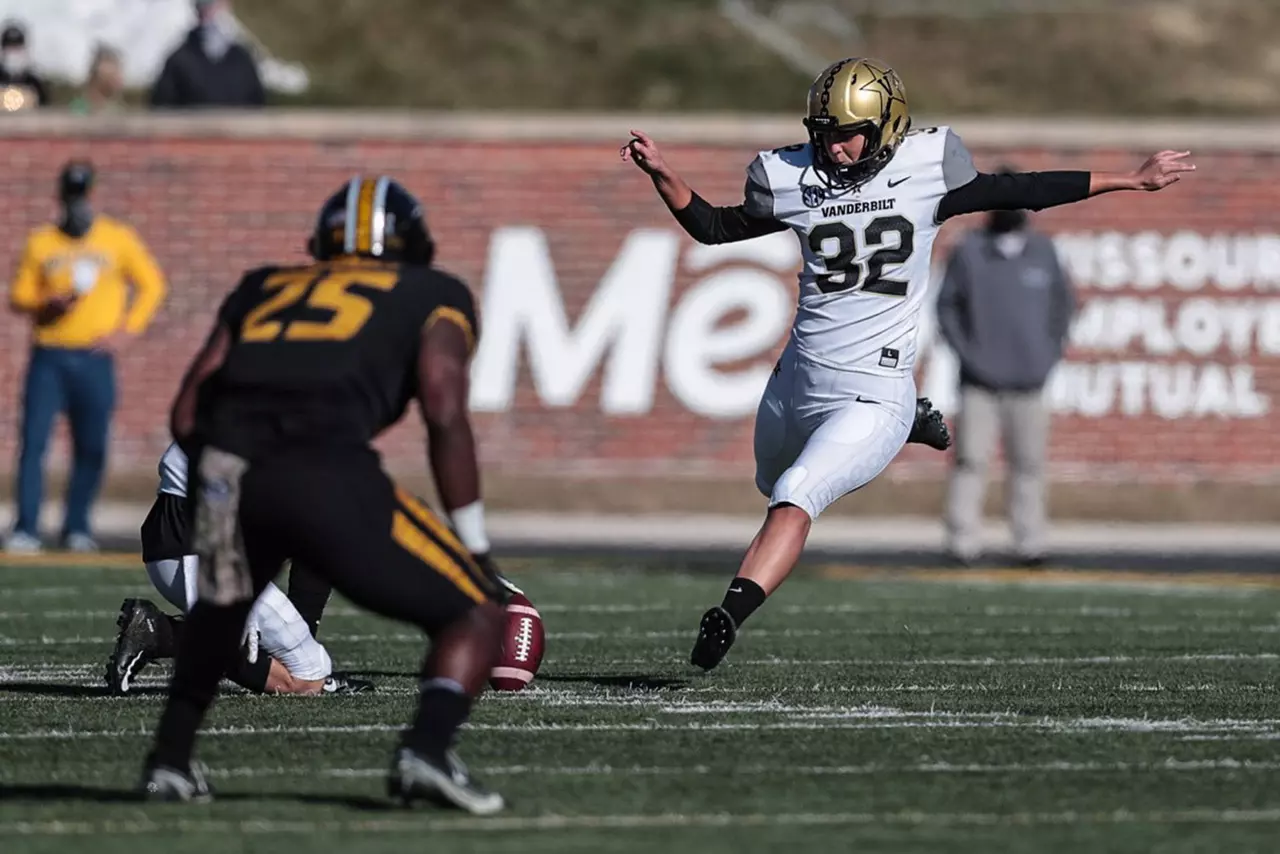
Vanderbilt's Sarah Fuller kicks off in the second half against Missouri at Memorial Stadium in Columbia, Missouri, on Saturday, Nov. 28, 2020.
Hunter Dyke/Mizzou Athletics/Getty Images North America/TNS
DALLAS — When she is facilitating name, image and likeness (NIL) deals like the one a few months ago between University of Texas softball players and Walmart, the irony is never lost on Sarah Fuller.
She is just a few years removed from being a college athlete herself, one who earned national acclaim from becoming the first female to play for a power-five conference football team. She remembers, one November night at Vanderbilt in 2020, watching her social media following explode from 1,400 to 200,000.
Hailed as a “trailblazer” and “pioneer,” her story attracted widespread attention — she even introduced Vice President Kamala Harris in a video message for an inauguration event. It uniquely positioned her to capitalize on newfound fame by monetizing her name, image and likeness.
One problem: The NIL era didn’t start until July 2021. Fuller missed her NIL moment by seven months.
These days, the Wylie, Texas, native is Chief Athlete Officer at NOCAP Sports, which works with more than 60 schools, offering a suite of services that ultimately help put money into pockets of college athletes.
“I felt it firsthand being taken advantage of by your university and the NCAA,” Fuller told The Dallas Morning News.
“So my goal every day is to wake up and help support athletes. To make sure we’re putting the athlete front and center of everything we do, and making sure those funds go back to support athletes,” she said.
“That we’re bringing them good NIL deals, that they understand what kind of deal they’re getting into. That’s the biggest thing for me, getting to work with these athletes and bring them opportunities I wasn’t allowed to have.”
Fuller is a prominent example of a growing number of former college athletes — most of whom missed all or part of the NIL era — who now help lead companies that benefit athletes in this new multibillion-dollar paradigm. A memorable NCAA commercial in recent years said there are more than 400,000 student-athletes and most “will go pro in something other than sports.”
They have indeed.
They are now founders, executives and advocates. They say they are driven to help create pathways for athletes in a landscape long on financial opportunity but devoid of guardrails. Several with ties to Dallas-Fort Worth — including Fuller, Austin Elrod and Landon Goesling (TheLinkU), Jonathan Hoeflinger (Athletic Estate) and Ethan Barr (PlayerData) — have either founded or work for companies carving out unique niches in a chaotic industry.
Goesling played basketball for Coppell High and then played and served as a graduate assistant at the University of Houston. Now chief revenue officer for TheLinkU, Goesling said he will never forget the first NIL deal he facilitated for an athlete, pairing a dog kennel business with a starter from a prominent program. When he called the athlete to inform him of the deal, the player, home with his mom, broke down in tears on the phone, telling his mom, “Mom, I got an NIL deal!”
“I was like, holy cow, I’m here to change kids’ lives,” Goesling said. “Fast forward four years, we have student-athletes that have had NIL deals with companies and are working for those companies now.”
Scores of former athletes are deeply entrenched in various corners of this new world, including Opendorse’s Blake Lawrence (Nebraska football), FanWord’s Christopher Aumueller (Nebraska tennis) and Mit Winter (William & Mary basketball).
Winter is a Kansas City, Mo.-based college sports attorney whose practice focuses on representing athletes, agents, universities, NIL donor-funded collectives and businesses in the NIL space. He encounters so many athletes and families, he said, who have zero experience dealing with demands they confront in this new ecosystem, including complex NIL contracts.
“Knowing what I was like as a college athlete, and knowing what I didn’t know at that time, I’m motivated to ensure athletes are making good decisions and properly taking advantage of the opportunity and short period of time they have as a college athlete,” Winter, who was named one of the 80 most influential figures in the NIL space by Silver Waves Media, told The News. “College athletics provided a lot for me, so I hope to help athletes have that same outcome.”
Aumueller is CEO and founder of FanWord, an AI-powered storytelling platform that helps school communication teams write feature stories, game recaps and other digital content. He told The News it started as a passion project, telling the stories of college athletes beyond what people see on TV.
“If you’re a softball player from a small town in Nebraska,” he said, “you may impact and inspire other little girls to follow your footsteps. That has a ripple effect, especially if you do it for thousands of athletes.”
Continuing to be a voice for athletes
The call came the day after Fuller and her Vanderbilt soccer team won the SEC championship in 2020. Ken Masuhr, an assistant soccer coach, asked if Fuller would be interested in trying out as kicker for the football team, whose special teams unit had been ravaged by COVID-19-related opt-outs and quarantined players.
Fuller had never kicked a football. But she passed up a Thanksgiving trip home to try out. On Nov. 28, she became the first female to play in a power-five game at Missouri. She trended on Twitter. Her kickoff was the SEC Network’s most viewed tweet in its history at the time.
Then came the Tennessee game on Dec. 12, when she kicked two extra points. All of a sudden, her kicks, her name, her story went viral. Brands, including Amazon, reached out through direct messages about financial opportunities.
She talked to Vanderbilt’s compliance office and “they shut it all down.” At the same time, she saw T-shirts selling bearing her image.
“There was nothing I could really do about it other than sending like a cease and desist [letter],” Fuller said. “I couldn’t make any money off of it at that time.”
Before long, she delivered the video message at “Celebrating America” to introduce Harris, being featured alongside Bruce Springsteen, Justin Timberlake and Kareem Abdul-Jabbar. She received signed jerseys from NFL players. She attended the ESPY’s award show, where she was recognized.
She transferred to the University of North Texas, where she earned her MBA and finished her soccer career. She was permitted to monetize her brand at that point but missed the opportunity to maximize her most lucrative NIL moment from her football experience. At North Texas, she said she made enough money to “get off my parents’ payroll.�� She signed with the agency Wasserman and secured deals with companies such as Altra Running Shoes and H&R Block, whose campaign, “A Fair Shot,” was aimed at addressing gender disparities in NIL deals.
Now, Fuller believes the work she and NOCAP Sports are doing is critical because it addresses the biggest problem in college sports: donor fatigue. NOCAP, whose clients include Pittsburgh, South Carolina and Florida State, works with universities that put the company in touch with their alumni business owners. NOCAP essentially audits services the business is using, such as credit card processing, insurance, etc., and will switch them to NOCAP’s service providers. They save money, which can then flow back to the university or to athletes in NIL deals.
“Hey, you don’t have to write another check,” Fuller said of the message to businesses. “We’re just going to save you money.”
She remains a voice advocating for athletes. In particular, since typically 75% of a school’s revenue-sharing dollars flow to football players, Fuller has seen the current model be “super unfair” for female and Olympic sport athletes. She said she has daily conversations with universities that touch on a common theme: How can we pay our female athletes and still keep our star football and men’s basketball players amid salary cap restraints?
Fuller’s sentiments about ongoing fissures in college sports reflect growing concerns across the industry that the current financial model is unsustainable. Among campus leaders, TCU Athletic Director Mike Buddie recently told The News that the best financial structure moving forward entails welcoming college athletes to the negotiating table to collectively bargain financial parameters.
To that point, Fuller was among the former athletes who opted out of the landmark House settlement. She is a named plaintiff in another high-profile antitrust lawsuit, Fontenot vs. NCAA, which is led by former Colorado football player Alex Fontenot and seeks compensation for former athletes who competed before the NIL era and further changes to the industry’s business model.
“The NCAA does a good job of spewing their propaganda,” Fuller said. “When you’re in the sport and you’re seeing all those things, it’s easy to believe it. I want to continue to be a voice and an advocate for athletes and ensure they have their rights for years and years to come.”
Teaching schools ‘how to be a business’
Elrod never envisioned he’d found a college sports company that works with more than 30 schools.
He grew up in the D-FW area, played quarterback for the University of Houston and earned his MBA from Dallas Baptist University. In 2022, he founded TheLinkU, which works with athletic departments to generate what he calls “above-board” dollars for athletes beyond the $20.5 million salary cap threshold that schools are allowed to share annually with athletes.
“The need is extreme, and it’s urgent,” Elrod said. “The chaos that exists is tremendous. ... That is why I’m doing what I’m doing now. Because it’s moving the needle in a very complex space, and there’s a lot of opportunity from a business perspective.”
Elrod has a portfolio of non-sports companies that include Elrod Enterprises, Elrod Interiors, NCSC Pest & Wildlife, Coeur d’Alene Cleaning Services and Elrod Land & Cattle.
Early in the NIL era, he received a call to start Houston’s first NIL collective and said he applied his grassroots startup mentality. Then came seven-figure deals and media attention. Soon, coaches and administrators called asking, “Hey, could you consult for us and teach us what you’re doing at Houston?”
That gave birth to TheLinkU, which now works with schools such as the University of Arkansas, Texas A&M, the University of Mississippi and others. He says it fills a void in a space that lacks any semblance of infrastructure.
The company offers schools several services. Its NIL technology platform provides campus leaders with their own digital dashboards, helping compliance officers with contracts and athletic directors with revenue generation data.
TheLinkU also matches their national partners with a school’s donor-led businesses. For instance, if a local car dealership has a rat problem, TheLinkU will connect their pest control partner with the dealership, which pays the pest control company and a portion of that goes to the university to support NIL.
...