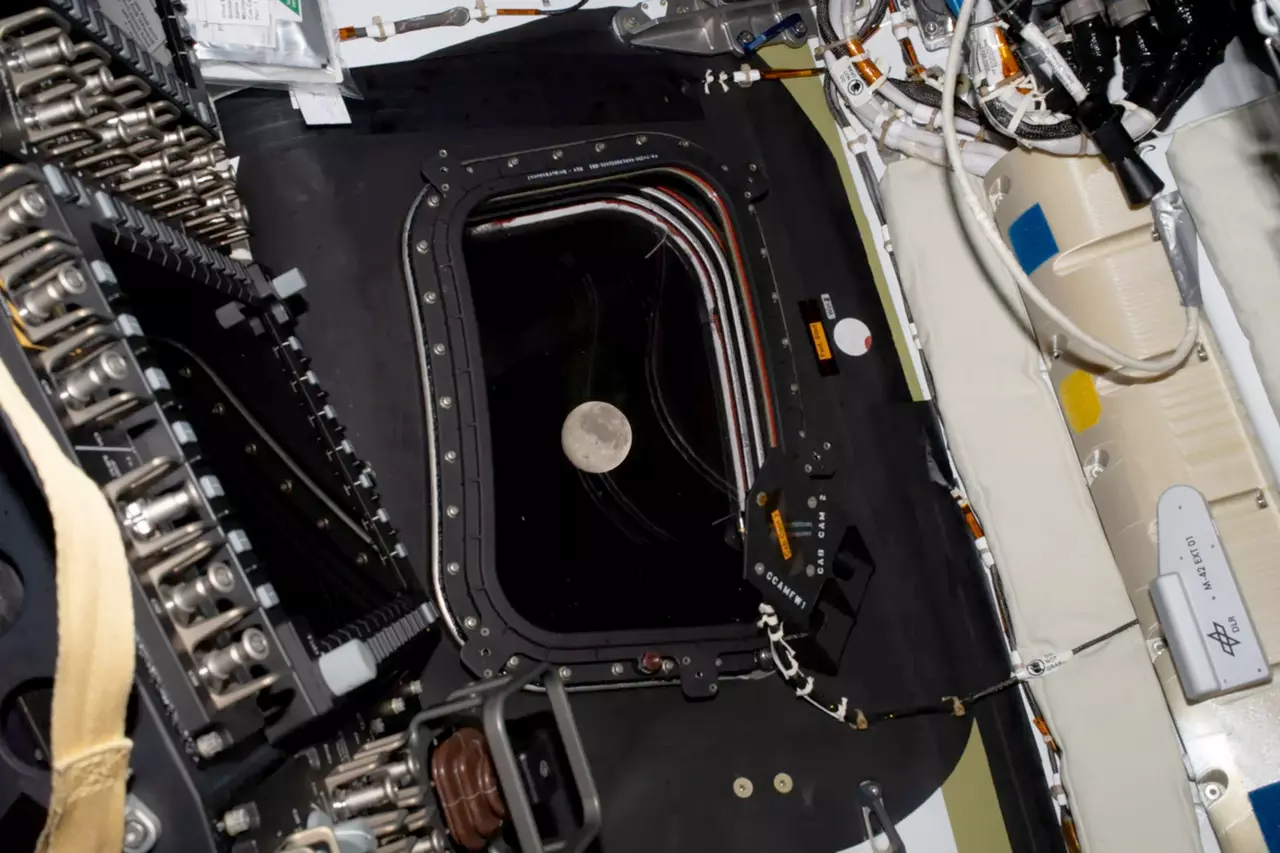

Moon’s gravity snags Artemis II on crew’s way to record-breaking day
The Orion spacecraft and its four passengers ventured into the moon’s gravitational influence Monday as the Artemis II mission sets up its way to a record-breaking day on the lunar far side before their trip back home to Earth. NASA astronauts Reid Wiseman, Victor Glover and Christina Koch along with Canadian Space Agency astronaut Jeremy Hansen will make their closest approach later Monday, ...
The moon can be seen out a window of the Orion spacecraft as the Artemis II crew make their approach Monday, April 6, 2026.
Handout/NASA/TNS
The Orion spacecraft and its four passengers ventured into the moon’s gravitational influence Monday as the Artemis II mission sets up its way to a record-breaking day on the lunar far side before their trip back home to Earth.
NASA astronauts Reid Wiseman, Victor Glover and Christina Koch along with Canadian Space Agency astronaut Jeremy Hansen will make their closest approach later Monday, but also surpass the farthest distance ever traveled from Earth by humans, a record held by the Apollo 13 crew set in 1970.
Since launching last Wednesday from Kennedy Space Center, the spacecraft has been under Earth’s dominant pull, but at 12:41 a.m., the moon took over that role.
“We noticed we entered the lunar sphere of influence about an hour ago and sure enough we are now falling to the moon rather than rising away from Earth,” said Koch on Monday morning. “It is an amazing milestone.”
Koch said the crew were able to see both a crescent Earth out the side hatch view and the moon out another of Orion’s windows at the same time.
“Definitely by far the moon is bigger than the Earth,” she said.
Now the crew will continue their approach as they slingshot around the far side of the moon. On their way, they will surpass the Apollo 13 milestone at 1:56 p.m. but then tack on more than 4,000 more files as whip around Earth’s satellite.
The crew will take observations all afternoon coming within 4,070 miles from its surface at 7:02 p.m.
After the fly by, Orion will continue to arc away from the Earth before gravity pulls it back to the planet reaching a new milestone distance of 252,757 miles.
All of this will happen as Orion is on the far side of the moon, and will be amid a predicted loss of communication for about 40 minutes.
At 7:25 p.m., the crew will be back within Earth’s view after coming back around the opposite edge of the moon.
Another unique event late Monday will be a solar eclipse from the crew’s perspective when the sun will pass behind the moon between 8:35-9:32 p.m.
The crew will have another four days back to Earth before a targeted splashdown Friday evening off the coast of San Diego in the Pacific Ocean to complete the 10-day journey.
--------