
Darren Bailey wins rematch bid against JB Pritzker in Illinois governor race
CHICAGO — Downstate farmer Darren Bailey, the unsuccessful Republican 2022 nominee against Gov. JB Pritzker, defeated three primary rivals Tuesday night to win his bid for a Nov. 3 rematch opposing the two-term Democratic chief executive, according to the Associated Press. With 37% of the expected statewide Republican primary vote counted, Bailey had 49% to 32% for Ted Dabrowski and 10% for ...
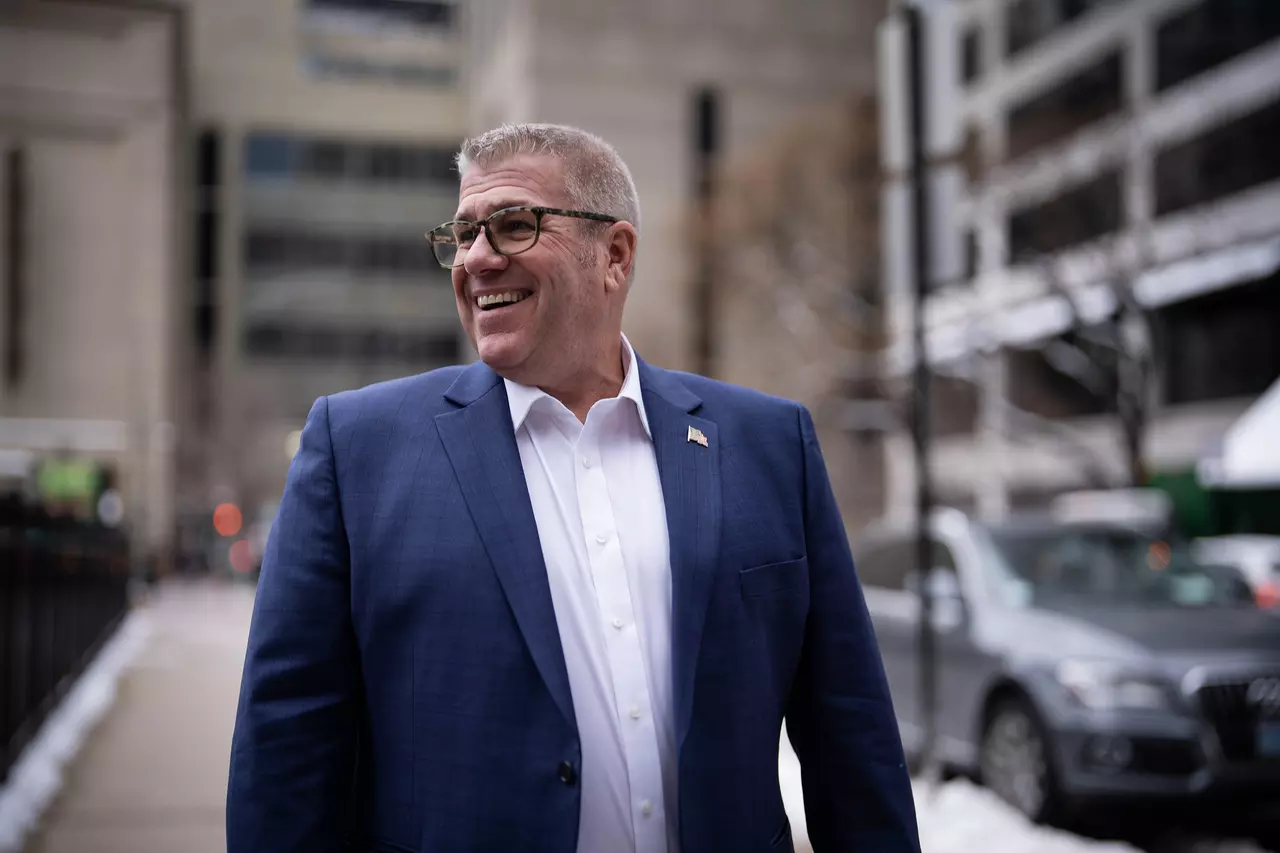
Darren Bailey, Republican candidate for governor of Illinois, leaves a series of media interviews at the Billy Goat Tavern, Dec.1, 2025, in Chicago.
E. Jason Wambsgans/Chicago Tribune/TNS
CHICAGO — Downstate farmer Darren Bailey, the unsuccessful Republican 2022 nominee against Gov. JB Pritzker, defeated three primary rivals Tuesday night to win his bid for a Nov. 3 rematch opposing the two-term Democratic chief executive, according to the Associated Press.
With 37% of the expected statewide Republican primary vote counted, Bailey had 49% to 32% for Ted Dabrowski and 10% for James Mendrick and 9% for Rick Heidner, according to unofficial results.
Pritzker, who was unopposed in the Democratic primary, spoke to supporters less than a half hour after the polls closed and with his GOP general election challenger still undecided. He used his victory speech to launch the Nov. 3 campaign and made it clear he will use it as a referendum on Republican President Donald Trump as he ponders a potential 2028 White House bid.
“Friends, this is the fight of our lives. Everything we care about is under siege from Washington,” said Pritzker, a businessman and billionaire heir to the Hyatt hotels fortune. “The Carnival Barker in Chief — sorry, the Commander in Thief — says there’s no federal money for health care and food assistance for families in need. But they had no trouble finding tens of millions of dollars to send masked troops with assault weapons onto the streets of Illinois to terrorize Americans.”
Pritzker said under his leadership, as other states “capitulated to Donald Trump, the seemingly unstoppable force of Trump’s unrestrained power met the immovable object of Illinoisans’ courage.”
“What is the Illinois Republican Party doing to help everyday people? Nothing. They want to roll out the red carpet for Donald Trump and his failed policies. Not once have they lifted a finger when Trump is closing rural hospitals or taking food away from poor children,” he said.
Pritzker’s remarks came as Bailey, Dabrowski, Heidner and Mendrick competed for the GOP nomination in what to the public has been a low-dollar, low-visibility contest for an office Republicans last held when one-term Gov. Bruce Rauner won in 2014, only to be defeated four years later by Pritzker.
Though all four pledged their fealty to Republican President Donald Trump, he did not endorse in the contest, as he had four years ago by backing Bailey.
Bailey was seeking a second chance against Pritzker after his near 13 percentage point general election loss to the incumbent governor four years ago. In the 2022 primary, Bailey captured an overwhelming 57.5% of the vote, defeating a field of five rivals, none of whom received more than 11% of the GOP ballots.
A charismatic evangelical Christian conservative from Xenia, Bailey downplayed the religious beliefs that had driven his previous campaign but turned off voters in the key Chicago suburbs. Lacking the money pumped into his win in a crowded primary field in 2022, Bailey this time counted on name recognition, chiefly among a solidly ruby red core of Republicans, to bolster his campaign.
While Bailey didn’t get Trump’s endorsement, the president encouraged him to make another run following the deaths of his son Zachary, daughter-in-law Kelsey and grandchildren Vada Rose, 12, and Samuel, 7, in a helicopter accident in southeastern Montana on Oct. 22. “I have no doubt that you will continue to Fight! Fight! Fight! for your beloved state in honor of your beautiful family.” Trump wrote Bailey in a letter of condolences.
Bailey, who in 2024 lost a primary challenge to veteran U.S. Rep. Mike Bost of Murphysboro, mounted his second bid for governor with a “mea culpa” tour, apologizing for terming Chicago a “hellhole” in his initial run and saying he now had a better appreciation of the city’s and suburban voters.
Dabrowski of Wilmette, the former president of the Wirepoints conservative activist organization, was backed by some of the same people who supported Bailey’s 2022 run but deemed him unelectable this time. They included far-right radio talk show host and GOP political operative Dan Proft of Naples, Florida, and Jeanne Ives, a former state representative of Wheaton, who founded her own right-wing advocacy group.
Dabrowski, a former bank executive, said he could appeal to suburban voters because he and his running mate were “professionals,” an apparent reference to Bailey’s farming background. Proft, a paid Dabrowski consultant who has helped send countless past campaigns to defeat, used a social media post to question the intelligence of Bailey supporters.
“He is solely living off residual awareness from four years ago. His supporters come from two camps: (1) those who lack intellectual curiosity to investigate the race, and (2) those who are baffled by the plot twists in Jim Varney movies,” Proft posted.
That prompted Bailey to say on social media that Dabrowski’s camp is “paying a single consultant $25,000 a month to call Illinois Republicans unintelligent and compare them to the Beverly Hillbillies is a window into how they really see this state.”
In his campaign, Dabrowski showed little charisma. Instead, he resembled a life insurance salesman touting actuarial tables, presenting the equivalent of PowerPoint presentations to potential voters, displaying number-filled charts and graphs about Illinois spending.
He vowed to declare a “safety” emergency and use gubernatorial executive orders to overturn state laws blocking local law enforcement cooperation with federal immigration agents who lacked a judicial warrant and creating cashless bail for nonviolent offenders. But such a pledge was of dubious legal authority since past emergency declarations by governors dealt with medical reasons, such as the pandemic.
Heidner, of Barrington Hills, a real estate developer and video gambling firm operator, made a late entry into the race, ran a few TV commercials, and sought to convince voters that they needed a businessman to run the state. He offered taxpayer funded tax credits to attract business with a goal of lowering taxes.
But Heidner also had problems understanding how state government functions. And he came off as an aggrieved businessman after Pritzker blocked the sale of property in Tinley Park that Heidner proposed for a horseracing track and casino following a Tribune report about his past connections with reputed members of organized crime. “I have zero ties to organized crime,” he said at a recent debate.
Heidner also apologized for making past donations to Democratic politicians, including former Cook County State’s Attorney Kim Foxx and Chicago Mayor Brandon Johnson. He explained he saw the money he gave to Johnson as an entry into discussing bringing legalized video gambling into Chicago with the mayor — which Dabrowski said appeared to be “pay-to-play politics.”
Mendrick, the two-term DuPage County sheriff from Woodridge, was the first candidate to enter the GOP contest but gained little traction. Cash-limited to social media videos, he often sounded like he was on a grade-school field trip when he visited downstate locations and marveled that “you could travel seven hours and not leave Illinois.”
Avidly opposed to immigrants, Mendrick echoed the call of the widely debunked, white nationalist Great Replacement Theory, contending “we are being replaced” by an immigrant population. He also has shown support for another debunked theory involving “constitutional sheriffs” which wrongly holds that sheriffs are the pre-eminent constitutional authority in their jurisdiction, even above the court system.
_____