
Minnesota sues Trump administration for evidence in Good, Pretti killings
MINNEAPOLIS — The state of Minnesota has sued the Trump administration, accusing its top law enforcement agencies of withholding evidence from the killings of Renee Good and Alex Pretti and the shooting of Julio Sosa-Celis in order to protect agents deployed for Operation Metro Surge from potential criminal charges. The lawsuit, filed Tuesday in U.S. District Court for the District of ...
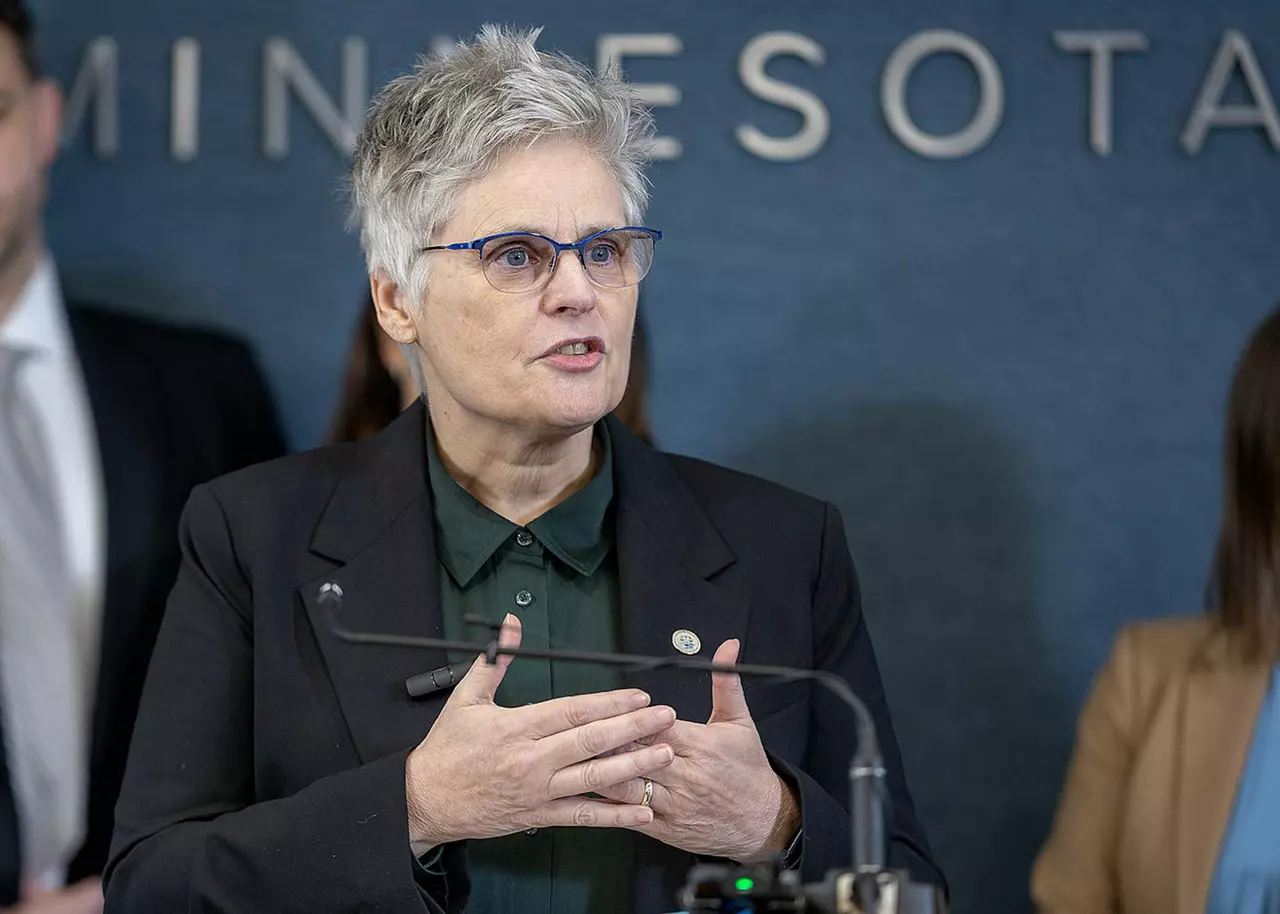
Hennepin County Attorney Mary Moriarty speaks during a news conference at the Hennepin County Government Center in Minneapolis on March 2, 2026.
Elizabeth Flores/The Minnesota Star Tribune/TNS
MINNEAPOLIS — The state of Minnesota has sued the Trump administration, accusing its top law enforcement agencies of withholding evidence from the killings of Renee Good and Alex Pretti and the shooting of Julio Sosa-Celis in order to protect agents deployed for Operation Metro Surge from potential criminal charges.
The lawsuit, filed Tuesday in U.S. District Court for the District of Columbia, argues that attempts by state officials to gather evidence into the shootings, including the names of the federal agents involved, have been shut down at the highest levels of the Trump administration.
“Principles of federalism do not permit the federal government to withhold investigative evidence for the purpose of shielding law enforcement officers from scrutiny where a State is investigating serious potential violations of its criminal laws, targeting its citizens, within its borders,” the petition reads.
The state of Minnesota, through Attorney General Keith Ellison, Hennepin County Attorney Mary Moriarty and Minnesota Bureau of Criminal Apprehension Superintendent Drew Evans are the plaintiffs in the lawsuit; the defendants are the U.S. Department of Justice, U.S. Department of Homeland Security, Attorney General Pam Bondi and former Homeland Security Secretary Kristi Noem.
Messages seeking comment were left with the White House, Justice Department and Homeland Security.
This is the latest in a series of legal maneuvers by Minnesota officials as they seek to hold federal agents accountable for potentially criminal activity during Operation Metro Surge. It comes more than seven weeks after Moriarty filed the first of multiple Touhy letters with the federal government seeking evidence from the shootings. The letters represent the formal process for obtaining records and evidence from federal agencies, and the lack of response from the Trump administration led to this lawsuit.
The investigative aftermath of three high-profile incidents are highlighted in the petition: the killing of Good in south Minneapolis on Jan. 7; the shooting of Sosa-Celis in north Minneapolis on Jan. 14; and the killing of Pretti in south Minneapolis on Jan. 24. All three incidents remain under criminal investigation by state officials.
The lawsuit argues that the blanket decision to not share evidence with Minnesota law enforcement in any of the three cases — and, in the state’s opinion, to not provide any substantive legal response to the Touhy letters — shows the Justice Department and Homeland Security are making “arbitrary and capricious” decisions in violation of the Administrative Procedure Act. It also argues that withholding the evidence violates Minnesota’s 10th Amendment right to carry out its police powers.
In an interview, Moriarty said filing the lawsuit in the nation’s capitol was a calculated decision because of the federal court’s expertise on federal agencies, but also for the location’s symbolic weight.
“It’s like we’re going right to the heart of the administration with our demands,” she said. “This feels like we should be challenging the federal government at the federal government.”
The lawsuit details how state and federal law enforcement collaborated on criminal investigations for decades in Minnesota — including on deadly use of force by federal agents.
“The longstanding practice of cooperation and evidence-sharing between federal and Minnesota law enforcement authorities broke down during DHS’s Operation Metro Surge,” the suit reads.
After Good was shot and killed on Portland Avenue on Jan. 7, the BCA arrived and began collecting evidence. An agreement was quickly made with the FBI’s Minneapolis field office for a joint investigation. Joe Thompson, serving at the time as first assistant U.S. attorney, confirmed the joint investigation that morning with the Hennepin County Attorney’s Office.
That agreement led BCA investigators to believe that “important evidence gathered by federal investigators would be made available to them for inspection and analysis.” That included Good’s car, the shell casings at the scene and the firearm used to kill Good. BCA agents also went to the Whipple Federal Building to interview the federal agents involved in the shooting, and the FBI told the BCA they would be allowed to conduct those interviews.
“Less than an hour later,” the suit reads, “BCA agents were told that the position of the federal government had changed and that (Homeland Security Investigations) would not allow BCA agents to be present.” That decision came from Washington, D.C., and was communicated by Daniel Rosen, the U.S. attorney for Minnesota. The night Good was killed, Rosen told Evans there would be no joint investigation and “no federal cooperation or evidence-sharing with state officials.”
In mid-January, U.S. Deputy Attorney General Todd Blanche announced there would be no federal investigation into Good’s killing. The lawsuit says the lack of a federal investigation into Good’s death was confirmed on March 18, “when the FBI informed Minnesota Authorities all evidence in their possession would be transferred to (the Department of Homeland Security), thereby ending any federal effort for a criminal investigation into the incident.”
The lawsuit argues that decision shows the federal government is ignoring “evidence suggesting the shooting may have violated federal law” and is inconsistent with “longstanding federal practice to conduct criminal investigations under such circumstances.”
After Pretti was shot and killed by two federal agents Jan. 24, state law enforcement was immediately blocked from the investigation.
When BCA investigators arrived on Nicollet Avenue to collect physical evidence, the federal agent serving as the ”incident commander” told them he was ordered to only allow the FBI onto the scene. When BCA investigators asked the FBI if the BCA’s crime scene team could assist, they were refused. The BCA obtained a warrant from a district judge in Minnesota authorizing their access to the scene, but the warrant was ignored.
The lawsuit claims that later that day, BCA agents went to Whipple to conduct interviews with the federal agents who had shot and killed Pretti. They waited for hours and were ultimately told that Homeland Security Investigations was leading the investigation into the deadly use of force, with the FBI assisting. The federal government still has Pretti’s cellphone, which recorded the moments leading up to his killing, and state investigators still do not have the names of the two masked officers who shot Pretti.
As outrage grew over both the killing of Pretti and the lack of cooperation between the state and federal government, there was a moment when a joint investigation seemed possible again. The lawsuit shows how the relationship fell apart.
On Feb. 5, nearly two weeks after Pretti was killed, the U.S. Attorney’s Office for Minnesota and the FBI reached out to the BCA “to indicate a desire to resume normal cooperation, including evidence-sharing and the potential for a joint investigation” into Pretti’s killing.
That same day, the Minnesota Star Tribune reported that the two sides were preparing to announce the agreement. It never materialized.
The lawsuit says that on Feb. 9, the Justice Department sent an attorney from its Washington, D.C., headquarters to Minneapolis to coordinate the response to the state’s requests for evidence. On Feb. 13, the BCA, FBI and U.S. attorney met and the U.S. attorney explained that the Justice Department expected the BCA to share whatever evidence it had gathered independently with the federal government, but the federal government would not be sharing its evidence with Minnesota law enforcement. That same day, the FBI told the BCA it would not be given any access to “information or evidence related to the death of Mr. Pretti.”
“Based on the sequence of events and the involvement of senior federal officials such as the U.S. Attorney, it is apparent that this decision was made at the highest levels of the DOJ,” the lawsuit says.
Shortly before that joint investigation fell apart, the Trump administration’s explanation for the shooting of Sosa-Celis in north Minneapolis on Jan. 14 came undone in federal court, with the federal agents involved placed on administrative leave for lying under oath.
But the lawsuit says in the immediate aftermath of that shooting, BCA and FBI agents “paired into teams to begin witness interviews and to complete a canvas of the area.” While the teams conducted several joint interviews, FBI agents collected evidence. Almost immediately, the FBI assistant special agent in charge put an end to the sharing of information.
The BCA obtained a judicial warrant to access the scene and was able to obtain some physical evidence but received nothing from federal agencies, including names and statements from the agents involved, the gun used, and the federal vehicle used in a car chase that preceded the shooting.
The Touhy letters were sent with urgent deadlines. The BCA aims to release its use-of-force investigations within 60 days of the incident because “the passage of time” can harm an investigation. That includes the fading of memory for witnesses and federal agents.
The state said there was also concern the federal government did not follow proper protocols in handling physical evidence at the scenes of the shootings. Hours after Pretti was shot, President Donald Trump posted a picture on his Truth Social account claiming to show Pretti’s gun. “The photograph shows the gun on the seat of a car, surrounded by two charging cords, which indicates it was not protected or handled according to normal law enforcement process meant to properly preserve evidence,” the suit reads.
Homeland Security argued that Touhy regulations “do not apply to disclosure of official information to federal, state or local law enforcement authorities related to criminal law enforcement investigations.” It also said it was referring the county attorney to the Justice Department because the DOJ was “leading the investigation into the subject matter you demand.”
The suit argues that Homeland Security referring the request to the Justice Department was improper and “reflected a broader policy” to not provide any evidence to state authorities, despite Homeland Security leading the investigations into deadly use of force in the killings of Good and Pretti.
The Justice Department did not respond to any of the Touhy letters.
The lawsuit asks the courts to force the Justice Department and Homeland Security to provide the evidence requested in all three shootings.
It was drafted by the Minnesota Attorney General’s Office and the Hennepin County Attorney’s Office, which had assistance from the Washington Litigation Group and the Institute for Constitutional Advocacy and Protection. Moriarty said those legal organizations, based in Washington, D.C., have expertise on federal courts and provided their services pro bono. Prosecutors with the Hennepin County Attorney’s Office have filed paperwork to practice in federal court in Minnesota and Washington, D.C.
Moriarty emphasized that no matter the outcome of the lawsuit, her office maintains the right to file charges if it determines a crime was committed in the killing of Good or Pretti or the shooting of Sosa-Celis. If charges are ever filed in those cases, it will unleash a one-of-a-kind legal situation for Minnesota.
She said this lawsuit aims to gain as much information as possible, and do so transparently.
“They are connected, but it’s important to think of the potential criminal cases separately,” she said. “Because we don’t necessarily have to wait until the end of this litigation to bring charges. That is where you get to the point where you’re really strategically thinking about, ‘OK. Do we have enough information? Does that information lead us to believe we should be filing charges?’”
_____