
Texas employment poised for sluggish growth after slow February, new Dallas Fed data shows
The Texas economy is now expected to add jobs at a rate of 1.4% in 2026, according to a model-based forecast from the Federal Reserve Bank of Dallas — a significant downshift from the bank's forecast just a few weeks ago. The bank's previous 2026 employment forecast, released in early April, had projected a growth rate of 1.9%, implying an addition of nearly 280,000 jobs and a significant ...
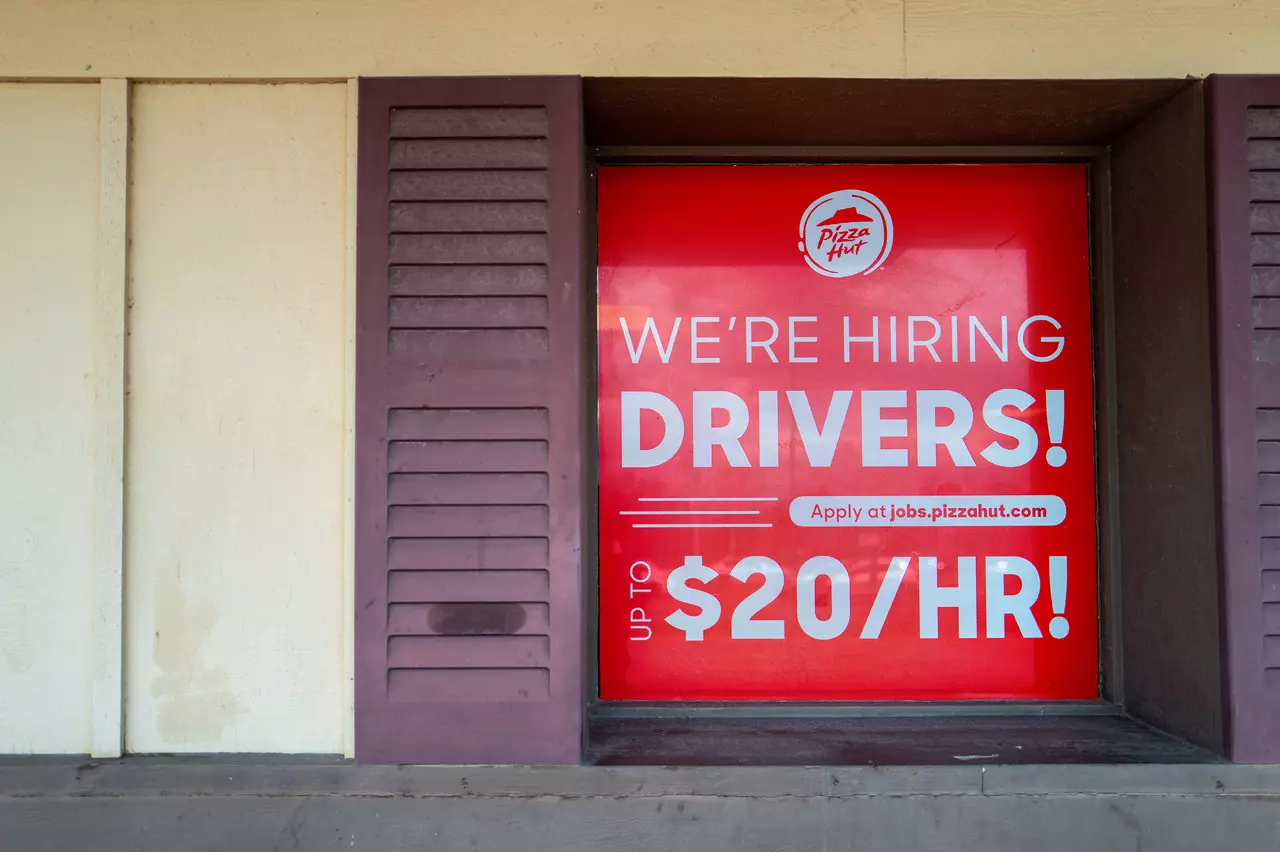
A hiring sign is displayed in a Pizza Hut store window on June 25, 2025 in Austin, Texas.
Brandon Bell/Getty Images North America/TNS
The Texas economy is now expected to add jobs at a rate of 1.4% in 2026, according to a model-based forecast from the Federal Reserve Bank of Dallas — a significant downshift from the bank's forecast just a few weeks ago.
The bank's previous 2026 employment forecast, released in early April, had projected a growth rate of 1.9%, implying an addition of nearly 280,000 jobs and a significant upswing from earlier estimates for the year. The latest forecast, released on Friday, implies an addition of around 206,000 jobs.
"Texas employment growth slowed sharply in February," Luis Torres, a Dallas Fed senior economist, said in a statement, "and year-to-date growth is now more aligned with earlier forecasts for 2026."
Those figures, though, are the midpoints on a wider statistical range the bank's modeling system projected. Even a few weeks ago — after the unexpectedly rosy 1.9% projection — researchers were cautioning that they expected the year-end number to land closer to the low point of the range because of several more lasting economic challenges, especially labor market constraints stemming from the Trump administration's immigration crackdown.
Torres reiterated that sentiment with the release of the new projection.
"Given several headwinds, our expectations are for this year's growth to come in at the lower end of the forecast's confidence band, at around 1.0 percent," he said in the release. "Declining immigration is constraining labor supply, and higher productivity is suppressing labor demand."
State business activity, meanwhile, has recently moderated, the bank's monthly surveys of executives around the state have shown, and labor demand has been low.
In February, the information, manufacturing and professional and business services sectors recorded jobs gains, the Dallas Fed's report noted, while trade and transportation, other services and oil and gas all notched employment losses. Construction and education and health services also recorded job losses — representing a reversal from those sectors' recent solid gains.
A stagnant jobs market
Early this year, researchers at the bank forecast a 1.1% employment growth rate for the state this year, a pace that would be only about half Texas' historically hot employment growth rate. Nevertheless, it also represent a sizeable upswing from 2025, when broader economic volatility and labor market constraints resulted in a growth rate of about 0.1%, economists concluded.
The latest forecast comes as both the country writ large and Texas have entered what analysts have dubbed a "low-hire, low-fire" economy, characterized by relatively muted hiring and but relatively few mass job losses. A recent analysis by The Dallas Morning News determined the same trend was occurring locally: In the first quarter of 2026, The News' analysis found, North Texas experienced fewer layoffs through federally-mandated WARN notices than during almost any other quarter since 2024.
At the same time, local employment gains have lately slowed, with both the Dallas and Fort Worth metro areas adding jobs at a pace of less than 1% last year, well below North Texas' pace the previous few years.
After a strong January, Dallas registered employment growth at just 0.1% in February, according to the Dallas Fed, while Fort Worth recorded a 1.4% employment decline. Austin, El Paso and San Antonio also posted declines that month, according to the bank.
The bank's widely watched employment forecast is based on the average of four models and includes factors such as oil prices, U.S. GDP growth and various economic indices.