
Evan Grant’s path to MLB labor peace: Salary cap and floor, growing baseball and more
SURPRISE, Ariz. — On Thursday morning in the Rangers clubhouse, owner Ray Davis stopped by Josh Jung’s locker, engaged in a brief, but pleasant chat about cars. Just chit chat. Really, nothing remarkable. Until you remember that Jung is the Rangers rep to the MLB Players Association. Then, it becomes a marvel! It is actually possible for owners and players to be in the same room. Add that it ...
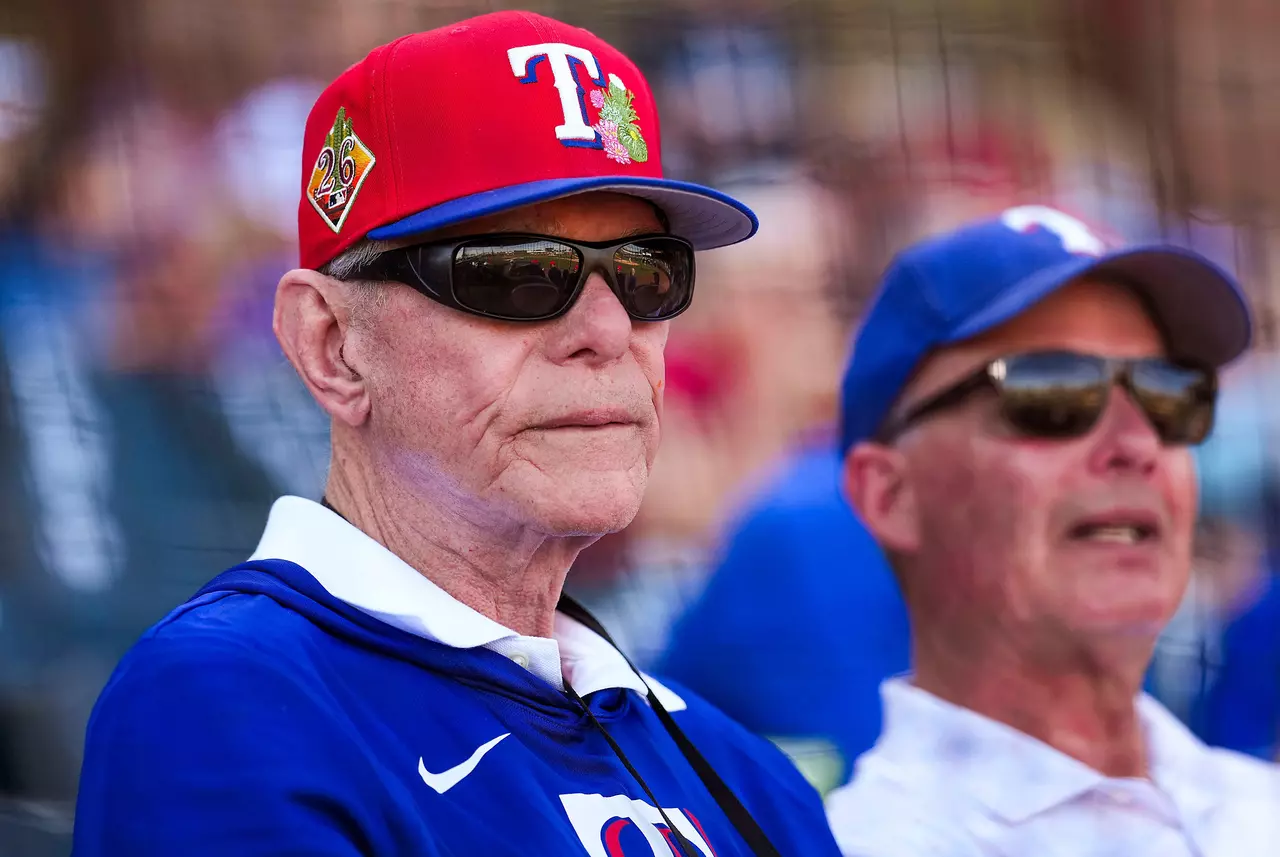
Texas Rangers managing partner and majority owner Ray C. Davis watches during the first inning of a spring training game against the Arizona Diamondbacks at Surprise Stadium on Tuesday, Feb. 24, 2026, in Surprise, Arizona.
Smiley N. Pool/The Dallas Morning News/TNS
SURPRISE, Ariz. — On Thursday morning in the Rangers clubhouse, owner Ray Davis stopped by Josh Jung’s locker, engaged in a brief, but pleasant chat about cars. Just chit chat. Really, nothing remarkable.
Until you remember that Jung is the Rangers rep to the MLB Players Association.
Then, it becomes a marvel! It is actually possible for owners and players to be in the same room.
Add that it took place less than 24 hours after the MLBPA held its annual camp visit, to talk about upcoming labor negotiations, and maybe somebody wants to call the biggest baseball fan in the history of the papacy, White Sox diehard Pope Leo XIV, to discuss miracle status.
Now if we could talk about an even bigger wonder: The idea of a new collective bargaining agreement without a work stoppage. Pray for us all. But before we attempt to solve it all for everybody, we must acknowledge the storm that is brewing.
On Wednesday, a bigger-than-usual contingent from the union had swung by the clubhouse. This was no usual update. There were so many former players in the union leadership group you could have assembled a pretty good old-timers team with former Rangers Rick Helling and Carlos Gomez among them. They met for nearly two hours with the Rangers, answering questions about former union head Tony Clark’s sudden resignation over an affair with his sister-in-law, but spent much more time on the upcoming round of bargaining after this season. Those had already promised to be challenging even before the disruption atop the union leadership.
Word is owners want a salary cap. They are dug in. They see franchise valuations in other major sports skyrocketing while theirs remain sub-orbital. Increased cost certainty would act as an accelerant. None of that is the players’ concern. It’s their responsibility to help owners win on the field; it’s up to owners to control their urges. And so you get a typical management-labor union standoff. Even if the dollar amounts are much larger, the principles remain the same. Management wants more of the pie and labor wants a fair split.
Using the pie analogy — everybody loves pie — the argument shouldn’t be over how the current pie is sliced, but to bake a much bigger, sweeter pie for everybody, the fan and consumer among them. It should be about growing the game. Especially one that has the heyday of perhaps the best player to ever walk the planet, the best Yankee hitter since Mickey Mantle and two once-in-a-generation pitchers both in the same generation. The thought of fans missing perhaps a full year of Ohtani, Judge, Skenes and Skubal would constitute a crime against the game and greatly inhibit growth.
“I think we’re in a really good spot right now and we’re really unified,” Jung said of the meeting. “And we feel like baseball is in a really good spot, too. Fan engagement is high. Ratings are up. We want to do everything we can to keep going.”
So how do they get there? How do they create an actual partnership that allows for maximum growth and the biggest pie? Well, here are some thoughts, though they do come from a sports writer, whose closest experience to high finance is squaring the occasional expense report:
Better define revenue
There are nearly 150 years of distrust toward owners from the players. Owners control the “books,” and have always found ways not to fully disclose the revenues owning a team affords. If owners want to get to a salary cap, they must be more transparent about the revenues afforded them by owning a baseball team. Many clubs have spun off operations that make bank on the back of facilities granted to owners for owning a club.
The Rangers, for example, spun off their events division into REV Entertainment, which presents a horde of events at Globe Life Field and also has branched into other venues, as well. By all accounts, it’s hugely successful … and doesn’t count toward the club’s revenues. Should it? Or should some portion, at least of the events staged at the stadium built specifically for the Rangers, count in the revenue pool? Those kinds of financial forensics have been as off-limits for players as a salary cap has been for owners. Want to grow the pie? Let everybody see all the ingredients first.
Salary floor
Again, before talking cap, talk about creating a realistic salary floor for owners. The goal here would be two-fold — to get the younger element of the PA more money and to root out owners who simply want to pocket revenue sharing checks and don’t honestly compete. If you don’t have the money to fill out a roster at a new floor, well, then cash out. According to Baseball Prospectus, 18 clubs are expected to have CBT payrolls of $185 million or more in 2026. Sounds like something in the $150 million-200 million range wouldn’t be an issue for most clubs.
Along with this, offer the PA a significant upgrade in pre-arbitration salaries, which currently sit at $780,000 per year. Double it at least. The Pirates want to hug the floor? OK, but they are gonna get there by paying everybody at least $1.5 million, with let’s say, $500,000 yearly increases until arbitration. Currently increases for 0-3 players average less than 10% of that.
Salary cap
OK, it doesn’t have to be a bad word. It can work to lift the salaries of the great majority of players, if it comes with a floor, and still leave room for elite players to earn elite money. Maybe combine the current luxury tax with a bit higher of a ceiling. Say you make the hard cap $350 million. Only two teams are there. But also phase in a tax for some top-tier teams. Let’s say the floor is at $200 million. At $250 million teams pay a 20% tax. It jumps by 10% at each $25 million interval. And 50% of the overage tax counts against the payroll, which really gets owners more like a $330 million cap.
Use the collected taxes to increase minor league salaries significantly and by that we mean $10,000-$20,000 annually.
The issue here is that there is still $130 million between the floor and the cap. If the idea is to create more competitive balance, there has to be some other vehicle included. In this system, do you have any idea how much a smart baseball organization could do with an extra $130 million? As we’ve proposed, it’s not going to get the Pirates and Dodgers on the same competitive plane, but the floor might drive out the current wave of owners and bring in fresh, more competitive blood.
Service and contract terms
Owners might need to give the players a quicker path to free agency to incentivize the cap more. Players might need to give owners the ability to limit contract lengths as a trade off. There’s got to be some path to discuss here. Players get free agency at five years; owners get limits of seven years on free-agent contracts?
A Super Max hybrid
Want to exceed the $350 million payroll, encourage investment into player development and strengthen ties between a player and a community? Well, incentivize keeping your own players. Perhaps look at a system where teams could invest in their own players without being financially penalized. Say the Pirates want to keep Skenes? OK, they make him a Super Max offer. By this we mean, the length of terms wouldn’t be subject to the above-mentioned potential limits. But more importantly, teams can offer their own players whatever they want without being penalized on the salary cap. The Rangers sign Wyatt Langford to a deal next spring. They can give him something that averages $30 million per year, but how much of that counts against the cap is limited. For a pre-arb player, maybe it’s $3 million per year and that cap increases with service time.
There would be incentive, though, for a player to sign with his original team. He could still wait to free agency, but there might be some restrictions on earnings for him based on possible term limits and based on a club’s salary cap situation.
Grow the pie
Working together to grow revenues and franchise valuations. Both sides understanding the complexities of the TV rights market and how 30 teams and their player partners could all best benefit. Constantly look for ways to grow revenues for all than for ways to make the most money individually.
Does this give baseball labor peace? Who knows. Did any labor lawyers who read this just spit out their coffee? Probably. Would owners bristle? Absolutely.
But if the idea is for everybody to see more money and for fans to see an even better product, there is a path.